 USA

When Do You Need an Inline Duct Booster Fan?
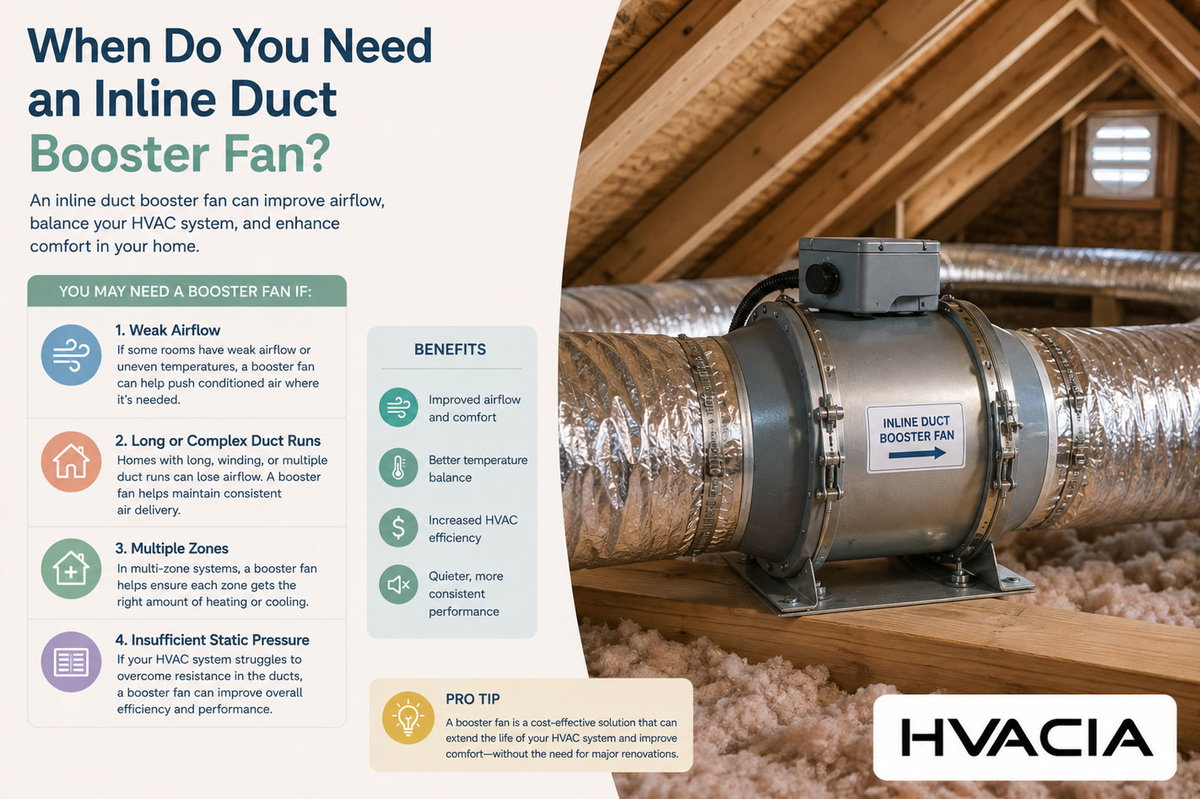
Every house has that one room. The nursery that never quite warms up in January. The bonus room over the garage that turns into a sauna every July. The finished basement that feels like a walk-in cooler no matter what the thermostat says. Homeowners usually blame the furnace, the AC unit, or "old windows" — and sometimes those really are the problem. But just as often, the real culprit is buried inside the walls: the ductwork simply can't deliver enough air to that one stubborn room.
That's where an inline duct booster fan comes in. It's a small, unglamorous device that solves a surprisingly common problem, and it's one of the most misunderstood tools in residential HVAC. Some homeowners install one and instantly fix a years-long comfort complaint. Others install one and just move the problem somewhere else, or worse, throw good money at a symptom instead of the disease.
This piece walks through exactly when a booster fan is the right call, when it's a band-aid, and how to tell the difference before you buy anything.
What Exactly Is an Inline Duct Booster Fan?
An inline duct booster fan is a small motorized fan that installs directly inside a section of ductwork — round or rectangular — to add extra push to the air moving through it. Unlike your furnace or air handler's main blower, which is designed to move air through the entire system, a booster fan is hyper-local. It's there to solve one specific bottleneck: usually a single duct run that's too long, too twisted, or too far from the main trunk line to get its fair share of airflow.
Most units are cylindrical, fit inside standard 4-, 6-, 8-, or 10-inch round ducts, and are activated either by a built-in thermostat, a manual switch, or — increasingly — a smart control that responds to temperature or humidity in the room it serves. Install one in the right spot, and it acts like a second heart pumping blood to a limb that wasn't getting enough circulation.
The U.S. Department of Energy has long noted that duct-related losses are one of the biggest hidden sources of inefficiency in home HVAC systems, and a booster fan is one of the few relatively inexpensive fixes that addresses a distribution problem rather than a generation problem — meaning it helps air get where it's going, rather than trying to make more of it.
The Telltale Signs Your Ductwork Is Struggling
Before you buy anything, it helps to know what a genuine "needs a booster fan" situation actually looks like. Here are the patterns that show up again and again.
Weak or Uneven Airflow
Hold your hand up to a supply register in the problem room. If the air trickles out compared to a register in a room that's comfortable, you've found your first clue. This isn't about the AC being "too small" — it's usually about how much of the air it does produce is actually reaching that particular vent.
Rooms That Never Reach Set Temperature
If your thermostat reads 72°F but a back bedroom stays at 78°F in summer or 65°F in winter no matter how long the system runs, that's a distribution problem, not a capacity problem. A furnace or AC that's correctly sized for the house as a whole can still starve one room if the ductwork serving it is inadequate.
Long Duct Runs and Excessive Bends
Air loses momentum the farther it travels, and every 90-degree elbow, every flex-duct kink, every transition from round to rectangular costs static pressure. A room at the far end of a long run, especially one with several turns along the way, is a textbook booster fan candidate.
Multi-Story Homes With Single-Zone Systems
Second and third floors are notoriously hard to condition evenly, especially in older homes retrofitted with central air. Heat rises, cool air sinks, and a single blower trying to serve every floor through one trunk line often shortchanges the upper level in summer and the lower level in winter.
Additions and Retrofits
When a sunroom, converted attic, or garage-to-living-space conversion gets tapped into existing ductwork, the original system was never sized for the extra square footage. The new space is almost always the one that suffers.
If you're nodding along to two or three of these, you're likely looking at a legitimate booster fan situation rather than a mechanical or thermostat issue.
How Booster Fans Actually Work
Mechanically, these devices are simple. Inside the housing sits a small motor spinning either a set of axial blades (like a box fan) or a centrifugal wheel (like a squirrel-cage blower). The fan slides into a section of ductwork, gets sealed with mastic or foil tape, and wires into either a dedicated switch, a duct-mounted thermostat, or a smart controller.
When triggered, the fan spins up and adds static pressure to that specific branch, essentially giving the air in that duct run an extra shove toward the register. It doesn't create more total airflow from the system — it redistributes what's already there, pulling a bit more toward the branch it's installed in.
This distinction matters enormously, and it's the single biggest thing people misunderstand about these devices.
When a Booster Fan Is the Right Call (and When It Isn't)
Good Candidates
- A single problem room fed by a long or convoluted duct run. This is the classic use case, and where booster fans perform best.
- Bonus rooms, converted attics, and garage additions tied into an undersized branch.
- Homes with a two-story layout and one central system where the upstairs runs hot in summer.
- Basements finished after the original HVAC install, where the duct was an afterthought.
When You Should Look Elsewhere First
- If every room in the house has weak airflow, the problem is almost certainly the main blower, a clogged filter, or an undersized system — not a single duct. A booster fan won't fix a system-wide deficiency; it just steals air from other rooms to feed the one it's installed in.
- If ducts are leaking or disconnected, sealing them will do more good than adding a fan. The EPA's ENERGY STAR program estimates that a typical home loses a significant share of conditioned air through leaky ductwork before it ever reaches a vent — and no booster fan compensates for a duct that's dumping air into a crawlspace.
- If the duct is severely undersized for the room's square footage, a booster fan is a temporary patch on a design flaw. At some point the physics catch up, and you'll want a proper duct resize instead.
- If your whole-house static pressure is already too high, adding a fan without addressing that pressure imbalance can create noise, strain the main blower, or unintentionally reduce airflow elsewhere in the house.
A good rule of thumb from HVAC professionals, echoed by resources like This Old House, is that a booster fan should be the second thing you try, not the first — after you've confirmed filters are clean, dampers are open, and there's no obvious duct leak or disconnection near the problem room.
Types of Inline Duct Booster Fans
Not all booster fans are built the same, and picking the wrong type is one of the more common — and avoidable — mistakes.
Centrifugal vs. Axial
Axial fans look like small box fans housed in a tube. They're inexpensive and move a reasonable amount of air, but they lose efficiency quickly against static pressure — meaning if the duct run they're boosting has a lot of resistance (long distance, tight bends), an axial fan's real-world performance can fall well short of its rated CFM.
Centrifugal (squirrel-cage) fans, by contrast, are better at pushing air against resistance. They cost more and are slightly bulkier, but for long or twisty runs, they typically outperform axial models by a wide margin. If your problem room is at the far end of a maze of ductwork, a centrifugal unit is usually worth the extra cost.
Speed-Controlled and Smart Models
Older booster fans were simple on/off devices, often triggered by a duct-mounted temperature sensor. Newer models offer variable speed control, app-based scheduling, and integration with smart thermostats — letting the fan ramp up only when the room actually needs help, rather than running at full blast constantly. This matters for both comfort (a fan running at full tilt 24/7 is noisy) and energy use.
Sizing and Placement: Getting It Right
Sizing a booster fan isn't about buying the biggest one you can find. Oversizing creates whistling, rattling ductwork and can actually starve neighboring branches by pulling too much air pressure toward the boosted run. Undersizing means you've spent money and changed nothing.
A few placement principles matter more than horsepower:
- Install it as close to the trunk line as possible, rather than right before the register. This lets the fan work with the longest possible stretch of duct rather than fighting turbulence right at the outlet.
- Avoid placing a fan immediately after a sharp bend. Turbulent air entering the fan reduces its efficiency and increases noise.
- Match the fan's diameter to the existing duct — reducers and adapters introduce their own resistance and often defeat the purpose of adding the fan in the first place.
- Leave a straight run of duct on both sides of the fan when possible — a few duct diameters' worth of straight pipe before and after helps the fan perform closer to its rated specs.
Manufacturers like Fantech and Suncourt publish CFM and static pressure charts for their booster fan lines, and cross-referencing those against your duct's length and bend count is worth the ten minutes it takes.
Installation Considerations
Installing a booster fan is a moderately involved DIY project for someone comfortable cutting into ductwork, but it's not always a simple plug-and-play affair.
- Power source: Most units need a dedicated electrical connection, ideally on a switched circuit or controlled by a duct thermostat so the fan doesn't run needlessly around the clock.
- Sealing: Every joint where the fan connects to existing ductwork should be sealed with mastic or foil-backed tape — not standard cloth "duct tape," which degrades over time and isn't rated for HVAC sealing.
- Access: Booster fans installed in unfinished basements or attics are far easier to service down the line than ones buried inside a finished wall or ceiling cavity. If you must install one somewhere hard to reach, choose a model with a strong reliability track record and consider an accessible service panel nearby.
- Noise: Even quiet centrifugal fans introduce some hum. Locating the fan farther from bedrooms, or choosing an insulated duct section around it, reduces the chance the fix becomes its own annoyance.
Homeowners who aren't confident diagnosing static pressure or duct sizing on their own are often better served bringing in a licensed HVAC technician for an assessment. Organizations like ASHRAE and directories from the Air Conditioning Contractors of America (ACCA) can help locate contractors familiar with residential duct diagnostics, including a Manual D duct evaluation, which formally calculates whether a room's ductwork is sized correctly for its load.
Common Mistakes People Make
Treating a booster fan as a substitute for duct sealing. Sealing leaky ducts almost always delivers more comfort and efficiency gain per dollar spent than adding a fan to a duct that's already losing air along the way.
Installing multiple booster fans without understanding total system pressure. Adding several fans to different branches without recalculating the whole system's static pressure can create winners and losers — some rooms get better, others mysteriously get worse, and the main blower can end up working harder than it should.
Choosing a fan based on price rather than static pressure rating. The cheapest axial fan on the shelf might move plenty of air in an open pipe, but drop it into a real duct system with bends and length, and its actual output can be a fraction of the number on the box.
Skipping the sealing step at the connection points. An improperly sealed booster fan installation can leak conditioned air into a crawlspace or attic — quietly undoing the very problem it was installed to fix.
Ignoring the return side of the system. Airflow is a loop. A booster fan on the supply side can't compensate for an undersized or blocked return, and in extreme cases, adding supply-side boost without addressing the return can actually depressurize a room, pulling in outside air through gaps around windows and doors.
Cost and Energy Considerations
Inline duct booster fans are refreshingly inexpensive as HVAC fixes go. Basic axial models often run in the $40–$80 range, while centrifugal and smart-controlled units can land anywhere from $100–$250 depending on size and features. Installation, if done by a professional, typically adds a modest labor charge for accessible duct sections, more if the fan needs to go somewhere tight or hard to reach.
Energy-wise, these fans draw relatively little power — most sip somewhere in the range of a nightlight to a small space heater on its lowest setting, depending on size and run time. Pairing the fan with a thermostatic control or smart trigger, rather than letting it run continuously, keeps both the electric bill and the wear on the motor in check.
Compared to the alternative — rerouting or resizing ductwork, which can run into the thousands depending on accessibility — a booster fan is often the most cost-effective first attempt at solving a single-room comfort problem, provided the diagnosis behind it is correct.
Alternatives to Consider First
Before buying a booster fan, it's worth ruling out cheaper or more foundational fixes:
- Open and balance existing dampers. Many duct systems have manual dampers that get closed or partially closed over the years, sometimes by a previous owner trying to solve a different comfort issue. A fully open damper on the problem branch may solve everything at zero cost.
- Replace a dirty filter. A clogged filter chokes airflow to the entire house, and the rooms farthest from the air handler usually suffer first and worst.
- Seal obvious duct leaks. Disconnected joints, torn flex duct, and gaps at boots are common, especially in older attics and crawlspaces, and sealing them is often more impactful than any fan.
- Add a transfer grille or jump duct between a starved room and a hallway, in cases where the issue is more about return air pressure than supply.
- Check register size and placement. An undersized register restricts airflow no matter how well the duct behind it performs.
If you've worked through this list and the room in question is still uncomfortable, a booster fan moves from "maybe" to "probably yes."
Frequently Asked Questions
Does a duct booster fan increase total airflow in my house? No. It redistributes existing airflow toward the branch it's installed in, which can mean slightly less air reaches other rooms on the same trunk line.
Can I install more than one booster fan in my home? Yes, but each addition changes the system's overall static pressure balance. It's worth having a professional confirm the main blower and return ducts can handle multiple boosted branches without strain.
Will a booster fan fix a room that's hot in summer and cold in winter? Often, yes, if the root cause is distribution rather than insulation, window efficiency, or an undersized HVAC system for the home overall.
How long do inline duct booster fans typically last? Most quality units are rated for several years of continuous cycling, similar in lifespan to a bathroom exhaust fan, with centrifugal models generally outlasting cheaper axial ones under heavy use.
Do booster fans work with both heating and cooling systems? Yes. Since they simply move air already conditioned by the furnace or AC, they work in either mode, though the ideal trigger settings may differ between seasons.
The Final Verdict
An inline duct booster fan earns its keep in a specific, well-defined scenario: one room, fed by a long or twisting duct run, struggling for airflow while the rest of the house is comfortable. In that situation, it's a small, affordable device that can turn an unusable bonus room into a functional part of the house.
Where it falls short is as a universal fix. If comfort problems show up in multiple rooms, if ducts are visibly leaking, or if the whole system seems undersized, a booster fan treats a symptom while the underlying cause keeps quietly working against you. The smartest move, before buying anything, is a short diagnostic pass — check filters, dampers, obvious leaks, and register sizing — and only reach for a booster fan once those simpler culprits have been ruled out.
Done right, it's one of the more satisfying home fixes available: a fifteen-dollar problem hiding behind a symptom that felt a lot bigger than it actually was.