 USA

Prevent Mold with a Dehumidifier: Complete Home Guide
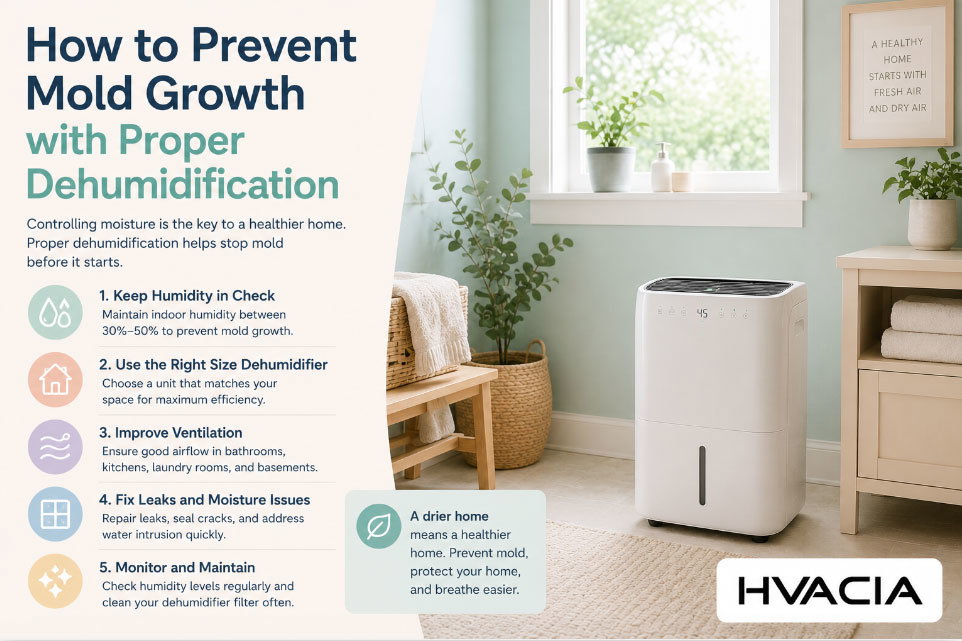
The first sign is rarely mold itself. It's a smell — faintly sour, a little like wet cardboard — that shows up in a closet, behind a dresser, or near a baseboard weeks before anything becomes visible. By the time an actual colony appears, the humidity that fed it has usually been sitting there quietly for a while, doing its work undisturbed. That's the part most homeowners get backwards: mold isn't really the problem. Moisture is. And the single most reliable way to prevent mold with a dehumidifier is to stop treating the machine like a mold killer and start treating it like a moisture manager, because that's the job it was actually built for.
This guide walks through what causes mold indoors in the first place, the exact humidity range that keeps it from taking hold, how to choose between the three main types of dehumidifiers, and the room-by-room habits that make the difference permanent instead of temporary.
Why Humidity Is the Real Root of Every Mold Problem
Mold spores are already in your home. They're in everyone's home — drifting in through open windows, riding in on grocery bags and shoe soles, sitting dormant in ordinary household dust. That part is unavoidable and, honestly, not worth losing sleep over. Spores only turn into an active colony when three conditions line up at once: a food source (drywall paper, wood framing, dust, even the thin film on tile grout all qualify), a survivable temperature, and moisture. Most homes clear the first two conditions without anyone doing anything at all.
That leaves moisture as the one lever a homeowner can actually pull. Dust and organic material are everywhere, and typical indoor temperatures sit comfortably in mold's preferred range regardless of the season. Humidity is the single variable that decides whether spores stay dormant indefinitely or start multiplying within days.
This is also why mold problems so often turn up somewhere that never technically flooded. A burst pipe gets noticed, mopped up, and dried out fast, because it's dramatic and hard to ignore. A basement that's chronically a little damp, a bathroom with an underpowered exhaust fan, or a closet built against a poorly insulated exterior wall gets none of that urgency — and slow, boring dampness is exactly the environment mold prefers. Every home has these quiet microclimates, and they're almost never the rooms people think to check first.
The Humidity Number That Actually Matters
If you take only one number away from this article, make it this one: indoor relative humidity should stay below 60 percent, and ideally somewhere between 30 and 50 percent. That's the range the U.S. Environmental Protection Agency has recommended for years in its guidance on mold and moisture, and it has held up because it reflects how mold actually behaves rather than a vague comfort preference someone picked out of the air.
Cross above 60 percent for a sustained stretch and the risk stops being theoretical. Mold can begin colonizing damp organic surfaces within 24 to 48 hours once conditions turn favorable — a much shorter window than most people assume, and one reason "I'll deal with it this weekend" is rarely a safe plan after a leak. A guest bathroom that stays steamy long after every shower, a closet against a cold exterior wall, or a basement that never quite dries out through a humid July can each cross that threshold locally, even while a hygrometer sitting in the middle of the room reads a perfectly reasonable number.
This is precisely where a dehumidifier earns its keep. Ventilation helps. Fixing leaks helps. But in plenty of homes — especially anywhere humid summers, below-grade rooms, or older insulation are involved — airflow and repairs alone can't reliably hold a space at 50 percent. A dehumidifier can, because it's actively pulling water out of the air rather than waiting for that moisture to find its own way out.
How a Dehumidifier Actually Stops Mold Before It Starts
Here's the part a lot of buying guides skip over: a dehumidifier doesn't kill mold. Bleach, more or less, kills mold on a surface. What a dehumidifier does is remove the condition mold needs in order to grow in the first place, which is a far more durable fix than any cleaning product.
Most residential units pull humid air in, pass it over a chilled coil (or, in desiccant models, a moisture-absorbing wheel), and release drier air back into the room. The water that used to be vapor drips into a reservoir or drains away on its own, and the relative humidity in that space drops accordingly. Run the unit consistently, and the room simply never climbs to the 60 percent threshold where mold gets a foothold to begin with.
This distinction matters because many people buy a dehumidifier only after they've already scrubbed a mold patch off a wall — treating it as a one-time cleanup tool rather than ongoing infrastructure. The bleach handles the visible colony. It does nothing about the humidity that grew it, which is exactly why the same corner so often turns moldy again within a season. Preventing mold with a dehumidifier only works if the unit runs long and consistently enough — ideally set on a humidistat rather than switched on and off by hand — to keep the room under that threshold day after day, not just in the week after you noticed a problem.
Compressor, Desiccant, or Whole-Home: Choosing the Right Type
Not every dehumidifier works the same way, and matching the wrong type to a space is one of the most common reasons people conclude "the dehumidifier just isn't working" when really it's simply the wrong tool for that particular room.
Refrigerant (compressor) dehumidifiers are the type most people picture: a fan pulls air over a chilled coil, moisture condenses out, and the unit collects or pumps it away. They're effective and relatively affordable, but they lose their edge in cold spaces. Below about 65°F, ice starts building up on the coils, which stops moisture removal and can eventually damage the compressor — a real issue in an unheated basement or garage through the colder months.
Desiccant dehumidifiers solve exactly that problem. Instead of a cold coil, they pass air over a moisture-absorbing material, usually silica gel, then vent the now-dry, slightly warm air back into the room. Because there's no compressor or refrigerant involved, they can keep working in temperatures as low as -4°F, which makes them the better call for crawl spaces, unheated basements, and anywhere winter temperatures dip low enough to frost a compressor's coils.
Whole-home (ducted) dehumidifiers tie directly into existing HVAC ductwork and condition an entire house from a single unit, usually installed in a basement or utility space. They cost more up front and need professional installation, but they remove the daily hassle of emptying tanks in multiple rooms and tend to be the quietest option, since the equipment sits well away from any living space.
One buying note worth knowing before you shop: in 2019 the U.S. Department of Energy changed how dehumidifier capacity gets tested, lowering the test temperature from 80°F to 65°F — a change that dropped the pints-per-day figure printed on the box by roughly 30 percent, even though the machines themselves stayed the same. A unit labeled 50 pints today performs close to what a 70-pint unit did before the standard changed. If you're comparing a new purchase against an older dehumidifier already sitting in your basement, the label alone won't tell you the whole story.
Here's how the three types stack up side by side:
| Feature | Refrigerant (Compressor) | Desiccant | Whole-Home (Ducted) |
|---|---|---|---|
| Best operating temperature | Above 65°F | As low as -4°F | Matches your HVAC zone |
| Ideal spaces | Living areas, warm basements | Cold basements, crawl spaces, garages | Entire home, single install |
| Moisture removal speed | Fast in warm, humid air | Steady regardless of temperature | High capacity, whole-structure |
| Noise level | Moderate compressor hum | Slightly louder (fan and heater) | Quiet — installed away from living space |
| Upfront cost | $180–$300 | $250–$450 | $1,500–$2,500 installed |
| Upkeep | Empty tank, clean coil and filter | Empty tank, occasional wheel service | Connects to a drain line, minimal upkeep |
For most single-room problems — a damp bedroom closet, a bathroom that never quite dries out — a portable compressor unit is plenty. For a basement or crawl space that runs cold for half the year, desiccant is usually the smarter buy despite the higher sticker price. And if humidity keeps showing up in more than one part of the house, a whole-home system often ends up cheaper over time than three or four portable units running simultaneously.
A Room-by-Room Playbook for Mold-Free Humidity
Humidity doesn't distribute itself evenly through a house. Each room generates its own moisture in its own way, so each one needs a slightly different response.
The Basement and Crawl Space
These are the most common trouble spots, and for good reason: below-grade spaces run naturally cooler, sit closer to soil moisture, and often have poor air circulation to begin with. Running a dehumidifier here continuously, paired with a vapor barrier over any exposed dirt in a crawl space, is often the single most effective way to prevent mold in a home, full stop. Route the unit's drain hose to a floor drain or sump pump rather than a bucket — a bucket that quietly fills up unnoticed is its own small humidity source.
The Bathroom
A hot shower can push relative humidity past 90 percent within minutes. The exhaust fan does most of the real work here, so run it during every shower and for at least 20 minutes afterward. In a bathroom without a window, or with a fan too weak for the room's size, a small, quiet dehumidifier tucked into a corner closes the gap — particularly overnight, when the door stays shut and moisture has nowhere else to go.
The Kitchen
Boiling pots, running dishwashers, and long stovetop sessions all add moisture to the air, usually without anyone noticing until the windows fog up. A range hood vented to the outside — not one that simply recirculates filtered air back into the room — matters more here than a standalone dehumidifier, though a unit in an adjoining space helps if the kitchen is open-concept and humidity tends to drift toward a nearby living area.
Bedrooms and Closets
Closets built against exterior walls, especially on a home's north or shaded side, run cooler than the rest of the room and are prone to condensation that homeowners rarely think to check for. A small closet dehumidifier — even a modest, non-electric moisture-absorbing tub for a tight space — combined with leaving closet doors cracked occasionally for airflow, prevents the quiet, out-of-sight growth that tends to surprise people the day they finally move a stored box.
The Laundry Room
An unvented or poorly vented dryer is one of the biggest hidden humidity sources in an average home. Confirm the exhaust vents fully to the outside, never into an attic, crawl space, or garage, and check the vent run periodically for lint buildup that forces moist air to escape somewhere it shouldn't.
Early Warning Signs Your Humidity Is Already a Problem
A dehumidifier does its best work before anything goes visibly wrong, so it helps to recognize what "already a problem" looks like:
- A persistent musty smell, especially in closets, basements, or behind furniture pushed against exterior walls
- Condensation that regularly forms on windows, pipes, or the inside face of exterior walls
- Paint that bubbles or peels, or wallpaper that starts lifting at the seams
- Wood doors, windowsills, or floors that swell, stick, or warp slightly out of shape
- Small dark spots collecting in corners, along baseboards, or under sinks
- Allergy or asthma symptoms that seem to ease up noticeably when you're away from home
None of these guarantees an active colony on its own, but together — or persisting for more than a few days — they're a strong signal that ambient humidity has already crossed the line mold needs.
Beyond the Machine: Daily Habits That Lock In Low Humidity
A dehumidifier is the centerpiece of humidity control, not the entire strategy. A handful of habits make the difference between a unit fighting a losing battle and one that barely has to work at all:
- Run bathroom and kitchen exhaust fans during and after any activity that generates steam
- Vent dryers, range hoods, and bathroom fans to the outside — never into an attic, crawl space, or wall cavity
- Keep gutters clear and grade soil away from the foundation so rainwater isn't pooling against the house
- Insulate cold surfaces like exposed pipes and exterior walls to cut down on the condensation that forms on them
- Clean or replace your dehumidifier's filter and empty its reservoir on a regular schedule — an unmaintained unit can grow mold inside its own housing, which defeats the entire purpose
- Keep a simple hygrometer in problem rooms so you're watching an actual reading instead of guessing by feel
When to Call In a Professional
Most day-to-day humidity control is well within reach for a homeowner. But there's a point where DIY stops being the right call. The EPA recommends bringing in a professional once visible mold growth covers more than 10 square feet, or if the damage involved contaminated water — roughly a 3-by-3-foot patch, which is a smaller area than most people picture when they hear the guideline. Mold hidden behind walls, growing inside HVAC ductwork, or reappearing in the same spot after repeated cleaning also warrants a specialist, as does any household with infants, elderly residents, or anyone managing a respiratory condition.
When hiring, look for technicians certified under the IICRC's mold remediation standard rather than someone offering a same-day bleach-and-paint job. Certification means they've been trained in containment, proper drying verification, and how to confirm a job is genuinely finished rather than just cosmetically cleaned up.
Trusted Resources for Homeowners
For readers who'd rather go straight to the source than take a blog's word for it, these organizations publish the guidance referenced throughout this piece:
- U.S. EPA – Mold and Moisture Guidance — Indoor Environments Division, 1200 Pennsylvania Avenue NW, Washington, DC 20460
- CDC – Mold and Health Information — 1600 Clifton Road NE, Atlanta, GA 30329
- IICRC – Find a Certified Remediation Professional — 4043 S Eastern Avenue, Las Vegas, NV 89119
Frequently Asked Questions
What humidity level actually prevents mold?
Keep indoor relative humidity below 60 percent, and ideally between 30 and 50 percent. That range starves mold of the moisture it needs without drying out wood floors, furniture, or your sinuses in the process.
Can a dehumidifier get rid of mold that's already growing?
Not on its own. A dehumidifier prevents new growth by controlling humidity, but existing mold needs to be physically cleaned or professionally remediated first. Run the dehumidifier afterward to keep that same spot from returning.
How quickly does mold actually grow after a leak?
Faster than most people expect. Under sustained damp conditions, mold can begin colonizing organic surfaces within 24 to 48 hours, which is why drying out a leak or spill quickly matters more than almost anything else you can do.
Do I need a dehumidifier in every room?
Usually not. Focus first on the rooms carrying the highest moisture load — basements, bathrooms, laundry rooms, and any closet on an exterior wall. A whole-home ducted system is worth considering once three or more rooms are consistently a problem.
What size dehumidifier does a basement need?
Most standard basements do well with a 30- to 50-pint unit under current testing standards. Larger, wetter, or unfinished basements with exposed dirt floors often need 50 pints or more, especially if the space doubles as a laundry area.
Is a small, non-electric dehumidifier enough for a closet?
For a single closet with mild dampness, a moisture-absorbing tub can help. Anywhere with visible condensation, a musty smell, or a history of mold does better with an electric unit — even a compact one — since it holds humidity below the threshold that actually matters.
The Bottom Line
Mold prevention isn't really about mold at all — it's about humidity discipline. Keep relative humidity in the 30-to-50-percent range, match the right type of dehumidifier to the right room, and back it up with the small daily habits that keep moisture from ever building up in the first place. Do that consistently, and the musty smell that usually shows up weeks before a mold problem never gets the chance to start.