 USA

UV Lights in HVAC Ductwork: Cost, Installation & Real Benefits Explained
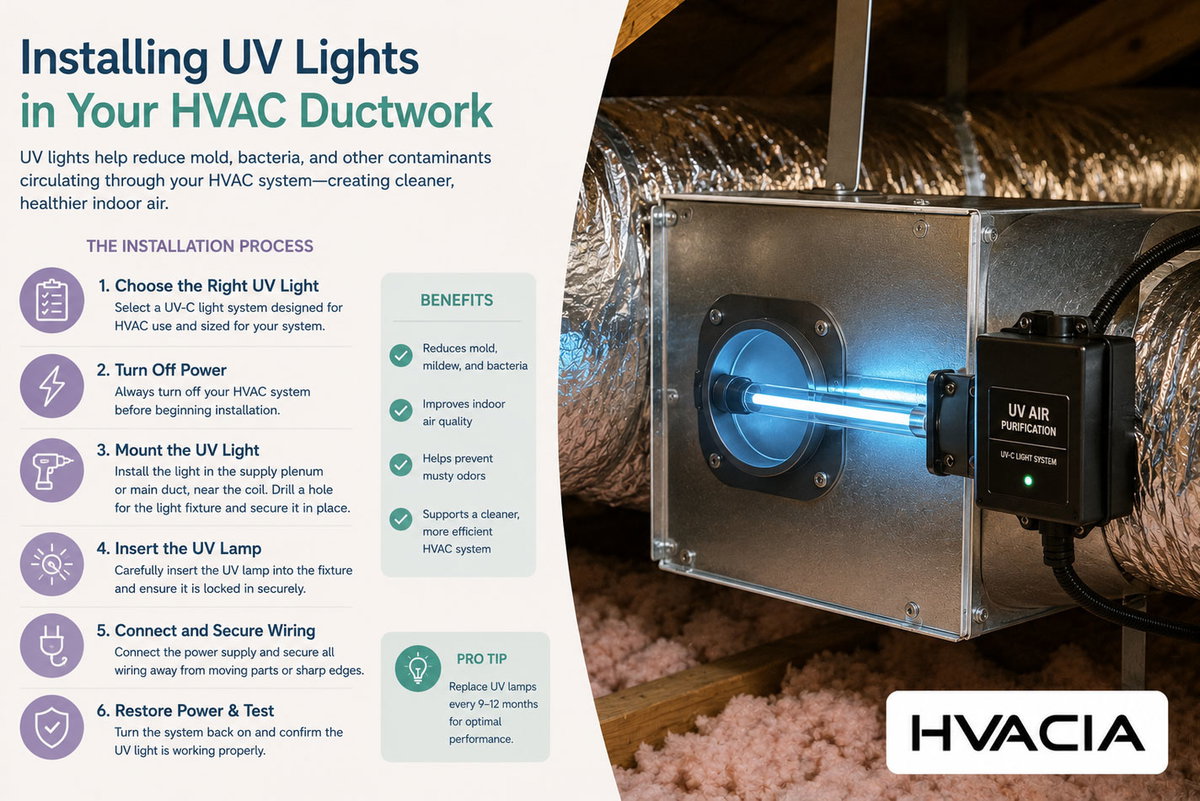
Quick answer: UV lights installed inside HVAC ductwork use short-wavelength ultraviolet light (UV-C) to damage the DNA of mold, bacteria, and viruses as they pass through the air handler or sit on cooling coils. A typical residential install costs $300 to $900 for a single coil-sanitizing bulb, or $600 to $1,500 for an in-duct air-sanitizing system, and takes a licensed HVAC technician one to three hours. UV light helps most with mold growth on evaporator coils and musty duct odors; it does far less for dust, pet dander, or general allergens, which still require filtration.
That's the summary. The rest of this piece is for anyone who wants to understand the mechanics, the trade-offs, and the questions worth asking a contractor before a UV lamp goes anywhere near their ductwork.
What Exactly Are UV Lights in HVAC Ductwork?
A duct-mounted UV light is a small germicidal lamp, usually housed in a sealed metal or polymer enclosure, wired directly into the HVAC system's air handler or duct run. It is not the same UV bulb you'd find in a tanning booth or a nail-curing lamp. HVAC-grade UV lights operate almost exclusively in the UV-C band, roughly 200 to 280 nanometers, which is the portion of the ultraviolet spectrum most effective at breaking apart the molecular bonds in microbial DNA and RNA.
The lamp sits inside a metal duct or plenum where it can't be seen once the system is closed up. A small viewport or indicator light on the outside lets a homeower or technician confirm it's still running. That's really the whole physical footprint: a tube, a ballast, a bracket, and a bit of wiring tied into the blower's power circuit.
The idea isn't new. Hospitals have used UV-C for surface and air disinfection since the 1930s, and it saw a resurgence in HVAC applications during the SARS-CoV-2 pandemic when building owners went looking for anything that might reduce airborne transmission risk. What's changed in the last decade is miniaturization and cost — a technology that once lived almost exclusively in hospital air-handling units is now a $400 add-on a residential HVAC company can install in an afternoon.
The Science: How UV-C Light Actually Disrupts Pathogens
UV-C photons are energetic enough to be absorbed by the thymine and cytosine bases in DNA (and uracil in RNA). That absorption creates abnormal bonds — pyrimidine dimers — that distort the genetic structure of a microorganism enough to stop it from replicating. A bacterium or mold spore that can't replicate is, for practical purposes, no longer a health threat, even if the cell itself isn't instantly destroyed.
Three variables determine whether this actually happens to a meaningful degree inside a duct system:
- Dose, which is intensity multiplied by exposure time. A weak bulb with air rushing past it at 400 feet per minute delivers a much lower dose than the same bulb positioned where air moves slowly or dwells longer.
- Wavelength, since germicidal effectiveness peaks around 260–265 nanometers. Cheaper bulbs that drift outside this range lose efficacy even if the box says "UV-C."
- Line of sight, because UV-C doesn't bend around corners or penetrate dust buildup. A lamp aimed at a coil will sanitize the coil surface facing it — not the back side, not the duct fifteen feet downstream unless it's specifically an air-sanitizing design.
This is the detail most marketing copy skips: a UV light doesn't "clean the air" in some general, ambient sense. It sanitizes what's directly in its beam path, for as long as that beam is uninterrupted.
Two Main Types of Duct UV Systems
Contractors generally install one of two configurations, and they solve different problems.
Coil Sanitizing (Surface) Lights
These are mounted near the evaporator coil — the cold, wet coil inside the air handler where condensation collects. That moisture, combined with dust and organic debris, makes coils one of the most common breeding grounds for mold and biofilm in a home's entire HVAC system. A coil light runs continuously, bathing the coil surface in low-level UV-C to keep mold and slime from colonizing it. This is the more common and generally more cost-effective install, and it's the one most manufacturers and independent testing agree has the clearest, most repeatable benefit.
Air Sanitizing (In-Duct) Lights
These are positioned directly in the airflow path, often paired with a higher-output lamp and sometimes a reflective chamber to increase exposure time as air passes through. The goal is to treat the moving air stream itself rather than just a stationary surface. These systems are more expensive, draw more power, and their real-world effectiveness depends heavily on airflow speed — since most residential duct air moves fast enough that dwell time in the UV zone is measured in a fraction of a second, which limits total dose. Higher-end systems compensate with multiple lamps or slower "kill chambers," but that adds cost and static pressure to the system.
Some installations combine both: a coil light for constant surface protection and an in-duct unit for airflow treatment. That combination is typically reserved for households dealing with documented mold issues, chronic respiratory sensitivities, or homes in humid climates where coil biofilm is a recurring problem.
Signs Your Ductwork Might Actually Benefit From UV
UV lights aren't a default upgrade every HVAC system needs. They tend to earn their cost in specific situations:
- A musty or mildew-like smell when the system first kicks on, which usually points to microbial growth on the coil.
- Visible mold or slime on the evaporator coil during a service visit.
- A home in a humid climate where the AC runs long hours and condensate lingers on the coil.
- A household member with mold sensitivities, asthma, or a compromised immune system where an HVAC technician or physician has specifically flagged airborne biological contaminants as a concern.
- Recurring coil cleanings that solve the smell temporarily but it returns within a few months.
If none of those apply — if the ductwork is clean, the home is in a dry climate, and the main complaint is dust or seasonal allergens — a UV light is unlikely to be the fix. That's a filtration and duct-sealing problem, not a UV problem.
The Real Benefits — And Where the Marketing Oversells
The credible, well-supported benefits:
- Reduced coil biofilm and mold growth, which is well-documented in both commercial and residential settings and is the primary reason UV coil lights exist in the first place.
- Less musty duct odor, since a large share of that smell originates from microbial activity on wet coil surfaces.
- Marginal reduction in airborne bacteria and viruses passing directly through the lamp's beam, though the magnitude depends heavily on airflow speed, lamp output, and system design.
- Slightly easier coil maintenance, since a clean coil also tends to run more efficiently, which can translate to modest energy savings over time.
Where marketing tends to overreach: claims that UV lights will "eliminate allergens," "purify whole-home air," or replace the need for filtration entirely. UV-C does essentially nothing to particulate matter like dust, pollen, or pet dander — it's a disinfection tool, not a filtration tool. Removing particles from air requires mechanical filtration (MERV-rated filters, HEPA filtration, or electrostatic precipitators), and no UV system substitutes for that. Reputable manufacturers are usually careful about this distinction; less scrupulous sales pitches sometimes aren't.
What UV Lights Won't Fix
Worth stating plainly, since this is where a lot of installs go wrong as an expectation-setting problem rather than a technical one:
- They won't remove existing dust, debris, or dander already inside the duct system — that requires actual duct cleaning.
- They won't seal leaky ductwork or fix poor airflow balance.
- They won't neutralize odors from pets, smoke, or cooking that have saturated porous duct materials over years.
- They won't compensate for an undersized or poorly maintained filter.
- They provide no protection against contaminants introduced after the air has passed the lamp — a UV light near the air handler does nothing for a moldy patch of ductwork in the crawlspace on the other side of the house.
Safety Considerations: Ozone, Eye Exposure, and Bulb Materials
A few genuine safety issues are worth understanding before installation, not after.
Ozone byproduct. Some UV lamps, particularly older or mercury-vapor designs operating below 240 nanometers, can generate small amounts of ozone as a byproduct. Ozone is a lung irritant even at low concentrations. Reputable HVAC-grade UV-C lamps are manufactured with ozone-free glass specifically to avoid this, and it's a reasonable question to ask a contractor directly: is this lamp ozone-free, and can you show the manufacturer spec confirming it?
Direct exposure. UV-C is damaging to unprotected skin and eyes with even brief direct exposure — this is why the lamps are installed inside sealed metal enclosures with the system powered down during service, and why technicians wear UV-rated eye protection when working near an active lamp. A properly installed system poses no exposure risk during normal operation because the light never escapes the duct or air handler housing. Problems arise only from poor installation — gaps, viewports without UV-blocking glass, or panels left ajar.
Material degradation. Sustained UV-C exposure can degrade certain plastics, foam duct liners, and rubber gaskets over years of continuous operation. This is a reason installers position lamps carefully and, in some cases, recommend UV-resistant duct liner materials nearby if the existing insulation isn't rated for it.
None of these are reasons to avoid UV installation outright — they're reasons to hire a licensed technician rather than attempt a DIY install with a mail-order kit of uncertain origin.
Where UV Lights Go in a Duct System
Placement is largely dictated by the type of system:
- Coil lights go inside the air handler cabinet, mounted six to eighteen inches from the evaporator coil, angled so the beam covers as much coil surface as possible without striking wiring insulation or plastic drain pans directly (which can degrade them over time).
- In-duct air-sanitizing lights are typically installed in the supply plenum immediately after the air handler, sometimes inside a dedicated straight section of duct that gives the airflow a longer, uninterrupted path through the UV zone.
- Systems are almost never installed in return ductwork, since the goal is treating conditioned air on its way out, and return-side placement would expose the lamp to more raw debris and shorten its service life.
Installation Walkthrough: What a Professional Install Actually Involves
For a straightforward coil-light installation, the process generally looks like this:
- System shutdown and access. The technician powers down the HVAC system and opens the air handler cabinet or an accessible duct panel near the coil.
- Mounting bracket placement. A bracket is fastened to the cabinet interior, positioned to aim the lamp at the coil face without obstructing airflow or the condensate pan.
- Electrical tie-in. The lamp is wired to a power source — either a dedicated low-voltage transformer or tied into the blower motor circuit so it runs whenever the system operates (some owners prefer a lamp that runs continuously regardless of blower status, which requires a separate always-on circuit).
- Sealing and safety check. Any duct penetration for wiring is sealed to prevent air leaks, and the technician confirms no UV light can escape through gaps, seams, or viewports.
- Startup and verification. The system is powered back on, the lamp's indicator light is checked, and airflow is confirmed to be unaffected.
In-duct air-sanitizing systems add a step: cutting an access section into the ductwork itself to mount the lamp housing inline with airflow, which requires more sheet-metal work and, in finished spaces, potentially some drywall or ceiling access.
DIY vs. Hiring a Professional
Kits marketed for DIY installation exist, and for a simple plug-in coil light on a system with easy air-handler access, a mechanically confident homeowner can technically do it. That said, there are real reasons most manufacturers and electricians recommend professional installation:
- Electrical tie-in risk. Wiring into an HVAC system's control board or blower circuit incorrectly can trip safety switches, damage the board, or create a fire risk.
- Warranty exposure. Many HVAC system warranties are voided by unauthorized modifications to the air handler, including improperly sealed penetrations for wiring.
- Placement accuracy. A lamp aimed incorrectly, or mounted too close to plastic components, delivers less benefit and shortens the life of surrounding parts.
- Safety verification. A licensed technician confirms no UV light escapes the sealed cabinet — something worth having a second set of trained eyes on.
For anyone still inclined to DIY, at minimum have a licensed electrician handle the power tie-in, and confirm the lamp housing is fully compatible with the specific air handler make and model before cutting anything.
Cost Breakdown
Pricing varies by region, system type, and whether it's a straightforward coil light or a more involved in-duct system:
| System type | Equipment cost | Installation labor | Total typical range |
|---|---|---|---|
| Basic coil-sanitizing UV light | $100–$300 | $150–$400 | $300–$700 |
| Higher-output coil light with extended-life bulb | $250–$500 | $150–$400 | $400–$900 |
| In-duct air-sanitizing system | $400–$900 | $300–$700 | $700–$1,600 |
| Dual system (coil + in-duct) | $600–$1,200 | $400–$800 | $1,000–$2,000 |
On top of the install, budget for replacement bulbs — typically $30 to $80 per bulb, replaced annually, since UV output degrades well before the bulb visibly fails. A lamp that looks like it's still working may be delivering a fraction of its original germicidal dose after 9,000 to 12,000 hours of runtime, which is roughly a year of continuous operation.
Maintenance and Bulb Replacement
UV bulbs are consumables, not permanent fixtures. Most HVAC-grade UV-C bulbs are rated for roughly 9,000 to 15,000 hours of continuous use — meaning most residential coil lights need a new bulb every 12 to 18 months, since they typically run whenever the blower does or continuously if wired to an always-on circuit.
A few maintenance habits keep the system performing as intended:
- Set a calendar reminder tied to bulb-life hours rather than relying on visible dimming, since UV-C output fades gradually and isn't always obvious to the eye.
- Keep the lamp's quartz sleeve or lens clean — dust buildup on the glass itself reduces the effective dose reaching the coil.
- Have the coil inspected during the same visit as bulb replacement, since a UV light reduces mold growth but doesn't eliminate the need for periodic coil cleaning altogether.
- Confirm the lamp's indicator light or app notification (on smart-enabled models) during routine HVAC tune-ups.
Choosing a System: What to Look for on the Spec Sheet
Not all UV lights are built to the same standard. When comparing options, a few line items matter more than brand name:
- Wavelength output, ideally centered near 254–265 nanometers for peak germicidal effectiveness.
- Ozone-free certification, confirmed in the manufacturer's spec sheet rather than taken on faith.
- Bulb lifespan and replacement cost, since a cheaper unit with expensive, hard-to-source replacement bulbs can cost more over five years than a pricier unit with commodity bulbs.
- Compatibility with your specific air handler, since duct dimensions and cabinet layouts vary by manufacturer and model year.
- Warranty terms, both on the UV unit itself and confirmation that installing it won't void the HVAC system's existing warranty.
Common Myths, Debunked
"UV lights replace the need for a good filter." They don't. UV disinfects; filters capture particles. A home needs both to meaningfully improve indoor air quality.
"More lamps always means more protection." Beyond a certain point, additional lamps mainly add static pressure and energy draw without proportional gains, especially if airflow speed is already limiting dwell time in the UV zone.
"UV lights are dangerous to have running in the house." Properly installed and sealed inside ductwork or an air handler cabinet, UV-C light never reaches occupied space. The danger only exists during improper installation or maintenance without power shutoff.
"Once installed, they never need attention." Bulbs degrade steadily and need replacement well before they visibly fail — a "set it and forget it" mentality quietly turns an active system into a decorative one.
Frequently Asked Questions
Do UV lights in ductwork actually work? Yes, for their intended purpose — sanitizing coil surfaces and, to a lesser extent, air passing directly through the lamp's beam. They're well-supported for reducing coil mold and biofilm; less so as a general air-purification solution.
How long do UV lights last in HVAC systems? The fixture itself can last many years, but the bulb inside typically needs replacement every 12 to 18 months, since germicidal output fades well before the bulb stops lighting up.
Will a UV light increase my energy bill? Minimally. Most residential UV lamps draw between 15 and 40 watts, comparable to a couple of LED light bulbs running continuously — a small, predictable addition to a monthly bill.
Can I install a UV light myself? Basic coil lights are sometimes DIY-installable, but the electrical tie-in and warranty implications make professional installation the safer default for most homeowners.
Do UV lights help with allergies? Indirectly at best. They target biological growth like mold and bacteria, not the dust, pollen, and dander that drive most seasonal allergy symptoms — those still require proper filtration.
Is ozone a real concern with these systems? It can be with lower-quality or older lamp designs. Confirming an ozone-free rating on the specific product being installed removes this concern entirely.
Trusted Resources and Organizations
For readers who want to go deeper — technical standards, consumer guidance, or finding a certified contractor — these are established, non-commercial starting points:
- U.S. Environmental Protection Agency (EPA), Indoor Air Quality Division — 1200 Pennsylvania Avenue NW, Washington, DC 20460 — www.epa.gov/indoor-air-quality-iaq
- ASHRAE (American Society of Heating, Refrigerating and Air-Conditioning Engineers) — 180 Technology Parkway NW, Peachtree Corners, GA 30092 — www.ashrae.org
- NADCA (National Air Duct Cleaners Association) — 1120 Route 73, Suite 200, Mount Laurel, NJ 08054 — www.nadca.com
- Centers for Disease Control and Prevention (CDC), Indoor Environmental Quality guidance — 1600 Clifton Road NE, Atlanta, GA 30329 — www.cdc.gov
These organizations don't sell UV equipment, which is precisely why they're useful reference points when comparing what a contractor tells you against independent technical standards.
Final Word
UV lights in HVAC ductwork are a genuinely useful, narrowly scoped tool — excellent at what they're built for, oversold when marketed as a cure-all. Installed correctly by someone who understands duct sealing, electrical safety, and bulb maintenance, a coil-sanitizing light can meaningfully reduce mold growth and musty odors for a modest ongoing cost. Installed as a substitute for filtration, duct sealing, or basic system maintenance, it becomes an expensive way to solve the wrong problem.
The most useful question to ask before signing off on an install isn't "does UV light work" — it does, within its physical limits — but "what specific problem in my system is this meant to solve." A coil with visible mold has a clear answer. A vague sense that the air "could be cleaner" usually points somewhere else first: the filter, the duct seals, or a professional indoor air quality assessment before any equipment gets purchased at all.