 USA

How Much Does It Cost to Replace an HVAC Compressor?
There's a particular kind of dread that comes with a warm draft blowing out of a vent on a 95-degree afternoon. You check the thermostat. You check the breaker. You call a technician, and twenty minutes later you hear the words every homeowner wants to avoid: "It's the compressor."
That single sentence is usually the most expensive one an HVAC contractor can say. The compressor is the engine of your entire cooling system, and when it fails, it rarely fails cheaply. If you're trying to figure out the true HVAC compressor replacement cost before you sign anything, this guide breaks down every variable that moves the number — tonnage, refrigerant type, warranty status, labor rates, and the decision math that tells you when replacing the whole system actually saves you money.
The Quick Answer: What Compressor Replacement Actually Costs
Pricing varies more than most people expect, mostly because "replace the compressor" can mean a $600 labor-only job or a $5,000 refrigerant nightmare depending on your system's age and warranty status.
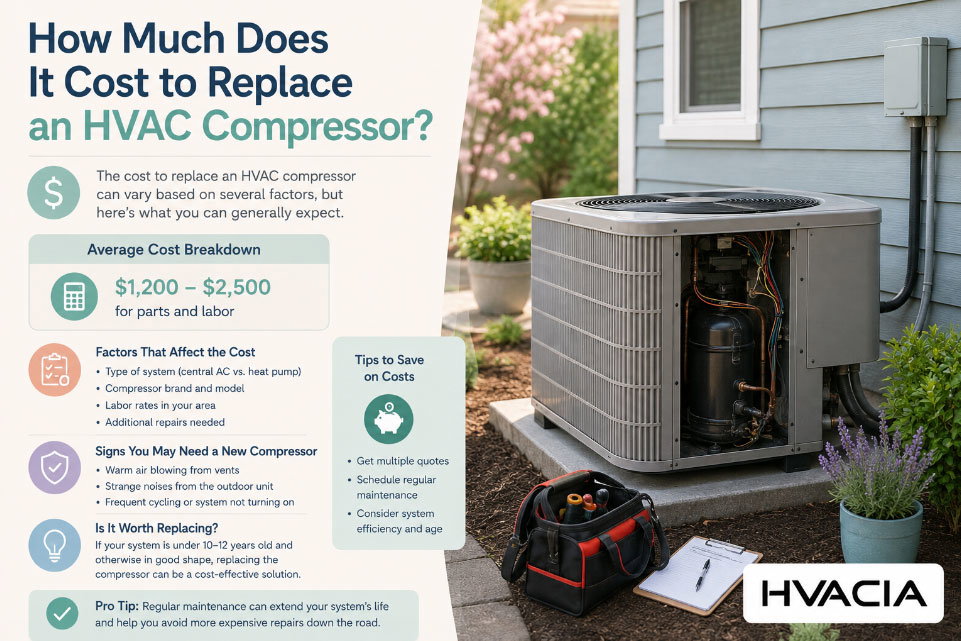
Pulling together data from multiple HVAC pricing guides, the national range for a residential AC or heat pump compressor replacement runs between $1,200 and $2,800 as of early 2026, though costs can climb past $3,000 on larger systems. Some guides put the average lower, around $1,200, with a typical range of $800 to $2,300, while others report a slightly higher national average near $1,600, with most homeowners paying between $850 and $2,400. Older systems tell a different story entirely — single-stage compressors on R-410A systems typically run $1,500 to $3,500 installed, while two-stage compressors land closer to $2,200 to $3,500.
So which number is "right"? All of them, depending on your unit. Here's the breakdown by system size.
HVAC Compressor Replacement Cost by System Size (Tonnage)
Tonnage — your system's cooling capacity, not its physical weight — is the single biggest driver of price. One ton equals 12,000 BTUs of cooling capacity, capable of cooling roughly 1,000 square feet, and every step up in tonnage means a bigger, pricier compressor.
| System Size (Tons) | Cooling Capacity (BTUs) | Compressor Part Only | Typical Installed Cost (Parts + Labor) |
|---|---|---|---|
| 1.5 | 18,000 | $700 – $1,300 | $1,300 – $2,300 |
| 2.0 | 24,000 | $800 – $1,400 | $1,400 – $2,500 |
| 2.5 | 30,000 | $900 – $1,600 | $1,600 – $2,700 |
| 3.0 | 36,000 | $1,000 – $2,100 | $1,800 – $3,000 |
| 3.5 | 42,000 | $1,100 – $2,200 | $1,900 – $3,200 |
| 4.0 | 48,000 | $1,200 – $2,100 | $2,000 – $3,300 |
| 4.5 | 54,000 | $1,300 – $2,300 | $2,100 – $3,500 |
| 5.0 | 60,000 | $1,800 – $2,600 | $2,600 – $4,000 |
Installed-cost estimates layer published labor ranges on top of part pricing and should be treated as a planning range, not a quote — get a written estimate for your specific unit.
Why the Compressor Costs So Much in the First Place
It helps to understand what you're actually paying for. The compressor is often described as the heart of the system because it does the heaviest mechanical work: pressurizing refrigerant gas and pushing it through the coils so heat can be absorbed indoors and released outside. It's a sealed, precision-engineered part that runs for thousands of hours under constant thermal and mechanical stress, and it typically has a working life of 12 to 15 years, with well-maintained units sometimes reaching 18 to 20.
Replacing it isn't a bolt-and-swap job. A technician has to recover refrigerant safely, cut and re-braze copper lines, pull a vacuum on the system, install and test the new part, and recharge the refrigerant to factory specification. Every one of those steps requires EPA Section 608 certification, specialized tools, and time — usually four to eight hours of skilled labor. That's why even a "simple" compressor swap rarely comes in under four figures.
The Six Factors That Actually Move the Price
1. System Size and Tonnage
Already covered above, but worth repeating: bigger systems need bigger, more expensive compressors, and there's no way around that math. Oversizing a replacement compressor to "get more cooling power" doesn't help either — mismatched sizing hurts efficiency and can shorten the new part's lifespan.
2. Compressor Type
Not all compressors are built the same, and you generally can't swap in a different type than what your system was designed for. Single-stage compressors, common in homes built before 2015, run at one speed and tend to be the least expensive to replace. Two-stage and variable-speed (inverter-driven) compressors cost more but deliver better efficiency and quieter operation, and they're increasingly standard in newer mid-range and premium units.
3. Refrigerant Type
This one catches a lot of homeowners off guard. If your system still runs on R-22 — common in anything installed before roughly 2010 — you're in for sticker shock. R-22 has been phased out of production, and it now costs $150 to $200 per pound when it can even be found, compared to R-410A, which has climbed from about $75 per pound in 2022 to $90–$150 per pound in 2026. A typical residential system holds 5 to 12 pounds of refrigerant, so on an R-22 unit, refrigerant alone can add over a thousand dollars to the bill.
4. Warranty Status
This is the single largest cost swing in the entire equation. Most major HVAC brands offer a 10-year parts warranty on the compressor when the system is registered within 60 to 90 days of installation. If your unit qualifies, the compressor itself could cost you nothing — you'd still owe for labor, refrigerant, and incidentals, typically $600 to $1,200 — instead of the full replacement price.
5. Labor Rates and Region
Labor is priced locally, and it shows. Certified HVAC technicians typically charge $50 to $150 per hour nationally, though in higher cost-of-living regions like Southern California, rates can run $75 to $150 per hour. Hard-to-reach units — rooftop condensers, cramped side-yard installs — tack on an extra $200 to $500 in labor. Peak summer demand pushes both wait times and pricing higher across the board.
6. Brand and Part Sourcing
OEM (original equipment manufacturer) compressors cost more than aftermarket parts but preserve compatibility and warranty eligibility. Premium brands like Carrier Infinity, Trane XL, and Lennox Elite generally use pricier, more complex components, which shows up in both the part cost and the install time.
In-Warranty vs. Out-of-Warranty: A Side-by-Side Comparison
Because warranty status swings the bill so dramatically, it deserves its own comparison table.
| Scenario | What You're Actually Paying For | Typical Total Cost |
|---|---|---|
| Compressor under active manufacturer warranty | Labor, refrigerant, filter-drier, and brazing materials only | $600 – $1,200 |
| Warranty expired, standard R-410A system | Full compressor part + labor + refrigerant | $1,500 – $3,500 |
| Older R-22 system, refrigerant phase-out pricing | Compressor + labor + high-cost legacy refrigerant | $3,500 – $5,000+ |
| Home warranty plan (contractor's choice of parts) | Service call fee plus deductible, if the claim is approved | Often under $500 out of pocket |
| Two-stage or variable-speed compressor, no warranty | Higher-end part + more complex install | $2,200 – $3,500 |
The takeaway: before authorizing any work, dig up your original installation paperwork or call the manufacturer directly to check registration status. It's the fastest way to turn a $2,500 job into a $900 one.
Signs Your Compressor Might Actually Be Failing
Not every cooling problem is a dead compressor, and it's worth getting a proper diagnosis before authorizing a four-figure repair. Common warning signs include warm air blowing from the vents, frequent circuit breaker trips, and loud humming or clicking noises coming from the outdoor unit. A system that short-cycles, won't turn on at all, or shows a sudden unexplained spike in your energy bill is also worth investigating.
Here's the part that saves people real money: compressor failure symptoms often look identical to cheaper problems, like a bad capacitor, a refrigerant leak, or a failing control board. A proper diagnostic — typically $80 to $200 — should include measurements of refrigerant pressure, electrical current draw, and a continuity test on the compressor's windings, not just a guess. If a technician tells you "it's the compressor" without showing you those readings, ask for them before you sign off.
Repair vs. Replace: The Math That Decides It
Once compressor failure is confirmed, the real decision isn't "how much does it cost" — it's "is it worth it." A simple rule used across several HVAC pricing guides: multiply the system's age in years by the proposed compressor cost. If the result tops roughly $5,000, a full system replacement is usually the smarter move, since the next major failure is likely right around the corner.
A few worked examples make this concrete:
- 5-year-old system, $1,800 compressor, still under warranty (labor-only cost of $400): 5 × 400 = 2,000. Replace the compressor.
- 8-year-old system, $2,400 compressor, warranty just expired: 8 × 2,400 = 19,200. Replace the whole system.
- 10-year-old R-22 system, $3,800 compressor plus $1,000 in refrigerant: The math and the refrigerant cost both point toward full replacement.
A related shortcut from another contractor guide: double the compressor quote, and if that number exceeds the price of a full new system, the compressor wins; if it's close, the full system usually wins because it comes with a complete warranty and, on newer equipment, meaningfully lower energy bills.
General industry guidance backs this up too — replacement of the whole outdoor unit tends to make more sense once a system passes the 10-to-12-year mark, or when the repair cost reaches roughly half the price of a new AC unit.
Compressor Replacement vs. Full System Replacement
| Option | Typical Cost Range | Best Fit |
|---|---|---|
| Compressor replacement only | $1,200 – $3,500 (higher for R-22 systems) | System under 10 years old, still under warranty, otherwise mechanically sound |
| Full HVAC/AC system replacement | $5,540 – $10,980 (unit, installation, old unit removal) | System over 10-12 years old, running R-22, or with a history of repeated failures |
The full-replacement number looks intimidating next to a $2,000 compressor quote, but it resets the clock on your entire system — new warranty, current-generation refrigerant, and typically a meaningful jump in efficiency, since 2026-era systems meeting minimum SEER2 standards can cut energy bills 20 to 40 percent compared to a decade-old unit.
How to Lower Your HVAC Compressor Replacement Cost
A few practical levers actually move the needle on price:
- Register your warranty immediately after installation. Missing that window is the single most expensive mistake homeowners make, given how much a covered compressor saves.
- Get a real diagnostic, not a guess. A $150 diagnostic that rules out a bad capacitor can save thousands.
- Get at least two or three quotes. Labor rates alone can swing from $50 to $150 an hour depending on the contractor, and part markups vary just as much.
- Ask about OEM vs. aftermarket parts. Aftermarket compressors cost less upfront but may carry shorter warranties — worth weighing against the savings.
- Maintain what you have. Annual coil cleaning, monthly filter changes, and a surge protector on the outdoor unit are inexpensive habits that meaningfully extend compressor life and delay this bill in the first place.
- Never attempt this yourself. Refrigerant handling requires EPA Section 608 certification by law, and DIY attempts can void warranties, damage the equipment, or cause serious injury.
Frequently Asked Questions
Is it ever cheaper to just replace the whole AC unit instead of the compressor? Often, yes — especially on systems over 10 years old or running R-22. Once the age-times-cost math crosses roughly $5,000, or the repair bill approaches half the price of a new system, full replacement usually wins on long-term value.
Does homeowners insurance or a home warranty cover compressor failure? Sometimes, if HVAC coverage is included in the policy. Be aware that home warranty companies typically assign their own contractor, may install an aftermarket or remanufactured compressor, and can take days to approve the work — a tradeoff worth weighing if you're mid-summer and need cooling restored fast.
How long does a new compressor last? With regular maintenance, most compressors run 12 to 15 years, occasionally reaching 18 to 20.
Can I legally replace a compressor myself? No. Handling refrigerant without EPA certification is illegal, and the brazing, vacuum, and electrical work involved make this a licensed-technician job, full stop.
Why is R-22 refrigerant so much more expensive than R-410A? R-22 production has been phased out under federal regulations, so supply is shrinking while demand from aging systems hasn't gone away. That imbalance is why it now runs $150 to $200 a pound, well above current R-410A pricing.
The Bottom Line
There's no single number that answers "how much does it cost to replace an HVAC compressor" — the honest answer is "it depends on four things: your system's size, its age, its refrigerant, and whether anyone remembered to register the warranty." For most homeowners, the realistic range sits between roughly $1,200 and $3,500, with warranty-covered jobs landing closer to $600–$1,200 and older R-22 systems pushing past $4,500. When the math starts approaching the cost of a full system, that's usually the signal to stop patching and start fresh.
Whatever quote lands in your inbox, get a second one, ask for the diagnostic readings, and check that warranty paperwork before you sign anything. It's the difference between a manageable repair bill and a genuinely painful one.
Sources & Further Reading
- HomeGuide – AC Compressor Cost Guide
- This Old House – AC Compressor Cost
- Today's Homeowner – AC Compressor Cost
- Florida Breeze – AC Compressor Replacement Cost
- Call Home Rangers – 2026 Compressor Cost Breakdown
- Jameson Heating and Air – Compressor Replacement Cost
- HVAC Pro Sales – Compressor Replacement Cost Guide
- HomeAdvisor – Home AC Compressor Replacement Cost
- The Furnace Outlet – Smart Homeowner's Cost Breakdown
- Power Pro Plumbing – AC Compressor Replacement Cost
- HVACDatabase – Compressor Failure Warning Signs
- Paradise Heating and Air – AC Compressor Cost
- CTR Air and Heat – Repair vs. Replace Guide
- Excel Mechanical – Compressor Replacement Cost Factors
- Mark Daniels Air Conditioning & Heating – Arizona Compressor Costs