 USA

Air-Source vs. Ground-Source Heat Pumps: 2026 Cost & Efficiency Comparison
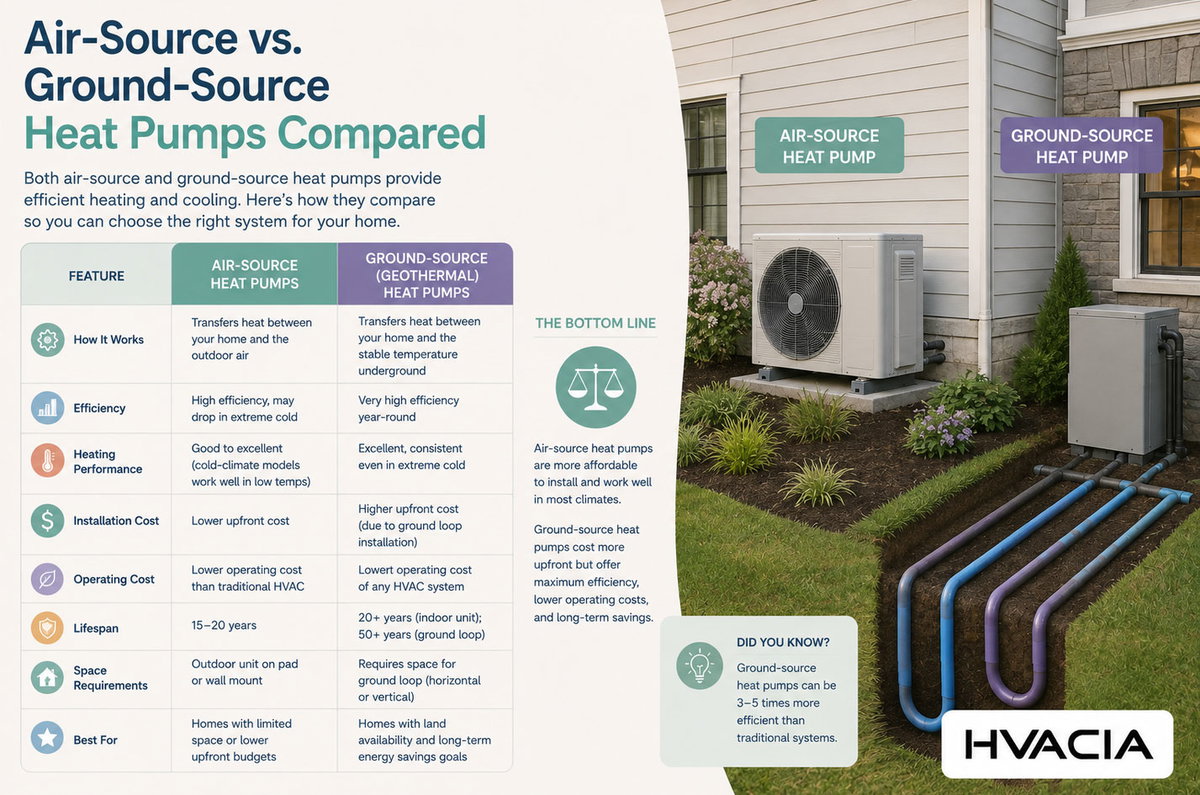
Every heating and cooling contractor has a favorite answer to this question, and that's part of the problem. Ask an HVAC installer who mostly does ductless mini-splits, and air-source wins every time. Ask a geothermal driller who just spent three weeks boring a 400-foot vertical loop field, and ground-source is the only system worth owning. Neither answer is dishonest. Both are incomplete.
The truth is that air-source and ground-source heat pumps solve the same basic problem — moving heat instead of generating it — using two fundamentally different heat reservoirs, two very different cost structures, and two very different sets of trade-offs. And the financial math changed meaningfully in 2026, after Congress eliminated the federal tax credits that used to make geothermal's steep upfront cost easier to swallow. This piece breaks down exactly how these systems differ, what they cost today, and how to figure out which one actually belongs on your property.
Quick Answer
Air-source heat pumps pull warmth from the outdoor air, cost $4,000–$20,000 installed, and work well almost everywhere except the harshest winters. Ground-source (geothermal) heat pumps pull warmth from the stable temperature underground, cost $18,000–$45,000 installed, run more efficiently year-round, but require yard space or acreage for a loop field and a much longer payback period now that federal tax credits for both technologies have expired. For most single-family homes on a standard lot, air-source is the practical choice. For rural or large properties in severe climates where owners plan to stay 20+ years, ground-source can still make sense.
How Each System Actually Moves Heat
Both technologies rely on the same core idea: a refrigerant loop absorbs heat from a low-temperature source, compresses it to raise its temperature, and releases it inside your home. Run the cycle in reverse, and the same equipment pulls heat out of your house for air conditioning. Neither system burns fuel. Both just move thermal energy from one place to another, which is why a well-installed heat pump can deliver three to five units of heat for every one unit of electricity it consumes.
Air-Source Heat Pumps (ASHP)
An air-source system exchanges heat directly with outdoor air through an outdoor condenser unit, similar in appearance to a central air conditioner. On a mild 45°F day, there's plenty of thermal energy in the air for the system to extract efficiently. As the temperature drops, that same air holds less usable heat, and the compressor has to work harder to pull the same amount out. Modern cold-climate models — the kind qualified under <cite index="29-1">ENERGY STAR's air-source heat pump program</cite> — have closed much of that gap with variable-speed compressors and enhanced vapor injection, allowing them to keep producing meaningful heat output even below 0°F. But physics still applies: the colder it gets outside, the harder an air-source unit has to work.
Ground-Source Heat Pumps (GSHP)
A ground-source, or geothermal, system skips the outdoor air entirely. Instead, it circulates fluid through a buried loop — horizontal trenches, a vertical bore field, or a submerged pond loop — that stays at a nearly constant <cite index="17-1">45°F to 75°F year-round</cite>, regardless of what's happening in the sky above. In January, that means the system is drawing heat from ground that's 40 or 50 degrees warmer than the outdoor air. In August, it means the system is rejecting heat into ground that's dramatically cooler than a 95°F afternoon. That stability is the entire selling point of geothermal, and it's why the technology posts efficiency numbers that air-source systems simply can't match on the coldest or hottest days of the year.
Installation Reality: What Actually Happens on Your Property
This is where the two technologies diverge most sharply, and where a lot of marketing material glosses over the messier details.
An air-source installation is comparatively simple. A crew mounts an outdoor unit on a pad or bracket, runs refrigerant lines to an indoor air handler or a set of wall-mounted heads, and the job is typically finished in one to three days. There's no excavation, no drilling, and no dependency on soil type or lot size. This is a large part of why ASHPs dominate retrofit installations in cities, townhomes, and any property where digging isn't an option.
Ground-source installation is a different undertaking altogether. Before a contractor can quote the job, they need to know your soil composition, available land, and local drilling regulations, because the ground loop — not the indoor equipment — is what drives both cost and disruption. There are three common loop configurations:
- Horizontal loops — trenched 4 to 6 feet deep across a large section of yard. Cheapest option, but needs roughly 1.5 acres of open, diggable land for a typical home.
- Vertical loops — bored 150 to 400 feet straight down. The go-to choice for smaller suburban lots, but drilling costs make it the most expensive loop type.
- Pond or lake loops — coiled pipe submerged in an existing body of water at least half an acre in size and 8 to 10 feet deep. The cheapest loop by far, when a suitable water source already exists on the property.
A consulting engineer at a home near 118 Cedar Hollow Road, Burlington, Vermont 05401 recently walked through this exact decision. The half-acre suburban lot couldn't support a horizontal trench field, so the only geothermal option was a vertical bore — quoted at just over $34,000 for a 4-ton system with two 250-foot boreholes. The homeowners ultimately installed a cold-climate air-source system instead, at roughly $11,000, because the lot simply wasn't large enough to make the vertical-loop math work in their favor.
Compare that with a rural property at 47 Quarry Hill Road, Ithaca, New York 14850, sitting on 6.5 acres with workable soil. There, a horizontal loop field was not only possible but inexpensive relative to a bore field — the same 4-ton geothermal system, with trenched loops instead of drilled ones, came in around $24,000. That's still a significant premium over air-source, but it's a very different number than the Vermont quote, purely because of what the land allowed.
The lesson: geothermal cost isn't really a function of the equipment. It's a function of your dirt.
Head-to-Head Comparison
| Factor | Air-Source Heat Pump | Ground-Source (Geothermal) Heat Pump |
|---|---|---|
| Typical installed cost | $4,000–$20,000 (ducted); $3,500–$6,000 per head (ductless) | $18,000–$45,000, sometimes higher on difficult sites |
| Heat source | Outdoor air | Buried ground loop or water source (45–75°F year-round) |
| Cold-weather COP | 1.5–2.5 at sub-freezing temps | 3.0–5.0, largely unaffected by outdoor air temperature |
| Installation time | 1–3 days, minimal disruption | 1–3 weeks, includes drilling or trenching |
| Property requirements | Small outdoor pad; works on almost any lot | 1–1.5 acres for horizontal loop, or room for a bore rig |
| Equipment lifespan | 15–20 years (outdoor unit) | 20–25 years (indoor unit); 50+ years (ground loop) |
| Annual maintenance cost | $80–$200 | $50–$150 |
| Noise | Audible outdoor unit, especially at high compressor speeds | Nearly silent; no outdoor unit |
| Backup heat needed? | Often, in climates below 5°F | Rarely — performance holds up in extreme cold |
| 2026 federal tax credit | None (Section 25C expired 12/31/2025) | None (Section 25D expired 12/31/2025) |
| Best fit | Most homes, suburban/urban lots, moderate-to-cold climates | Rural or large-lot properties, severe climates, long ownership horizon |
Efficiency: Where the Numbers Actually Come From
Efficiency is measured differently depending on which side of the cycle you're looking at. For cooling, both technologies use SEER2 or EER2 ratings. For heating, the relevant metric is the coefficient of performance, or COP — essentially, how many units of heat you get out for every unit of electricity you put in.
Air-source COP is climate-dependent by design. On a 47°F day, a good cold-climate unit might post a COP above 3.5. Drop the outdoor temperature to -5°F, and that same unit may fall to a COP of 1.5–2.0, meaning it's still more efficient than electric resistance heat, but nowhere near its rated peak. This variability is the single biggest technical argument geothermal advocates make, and it's a fair one.
Ground-source systems hold a COP in the 3.0–4.5 range essentially regardless of what's happening outside, because the ground loop rarely drops below 40°F even in a brutal winter. A field study of more than 1,000 installed units found that ground-source systems missed their expected efficiency targets in only about 2 percent of installations, compared to roughly 17 percent for air-source systems — a gap largely explained by how much harder ASHPs are to size and commission correctly for extreme climates.
That said, "more efficient" and "cheaper to run" aren't automatically the same thing once you account for the enormous difference in upfront cost, a distinction the next section covers in detail.
The Money Question: Upfront Cost, Operating Cost, and the Incentive Landscape That Just Changed
This is the section that shifted the most heading into 2026, and it's worth being direct about it: the two federal tax credits that used to narrow the price gap between these systems are both gone.
Under the Inflation Reduction Act, air-source heat pumps qualified for the Section 25C Energy Efficient Home Improvement Credit (up to $2,000), and geothermal systems qualified for the more generous Section 25D Residential Clean Energy Credit, an uncapped 30% credit that could knock $10,000 or more off a large geothermal installation. Both credits were scheduled to run through the early 2030s. The One Big Beautiful Bill Act, signed into law on July 4, 2025, terminated both credits early — for any equipment placed in service after December 31, 2025. There's no phase-down and no partial credit for 2026 installations. If your system went in before the deadline, you may still be able to claim the credit on a 2025 tax return; if it goes in during 2026 or later, the federal credit simply isn't available.
That single policy change reshaped the payback math for geothermal in particular. A geothermal installation that used to net out around $24,500 after a 30% credit on a $35,000 system now costs the full $35,000 out of pocket. Against a $12,000 air-source alternative, the gap used to be roughly $12,500 — now it's closer to $23,000, and it takes considerably longer for the extra efficiency to earn that money back.
What's still available:
- State energy office rebates, which vary widely and are unaffected by the federal repeal
- Utility rebate programs, often stackable with state incentives
- HEAR (Home Electrification and Appliance Rebates), an IRA-funded, state-administered program for income-qualified households, offering up to $8,000 toward a qualifying heat pump in participating states
- HOMES rebates, tied to measured or modeled whole-home energy savings
Because HEAR and HOMES money was already appropriated and distributed to state energy offices as grants rather than delivered through the tax code, the 2025 legislation didn't claw it back — but availability and funding levels differ by state, and some regional allocations have already been exhausted. Checking with your <a href="https://www.energystar.gov/rebate-finder">state energy office directly</a> before budgeting around a rebate is worth the ten minutes it takes.
On operating costs alone, geothermal typically saves a household somewhere between $200 and $500 per year compared to a cold-climate air-source system, depending on local electricity rates and climate severity. Run that against a $15,000–$25,000 upfront premium with no federal credit offsetting it, and the honest payback period for many households now stretches into the 40-to-60-year range — longer than the ground loop's own 50-year design life, in some cases, though shorter than that in regions with brutal winters and high electricity costs, where the efficiency gap does more work.
None of this means geothermal is a bad investment. It means the case for it now rests almost entirely on climate severity, electricity prices, and how long you plan to stay in the home — not on a tax credit doing the heavy lifting.
Can Your Property Even Support Ground-Source?
Before falling in love with geothermal's efficiency numbers, it's worth running a basic property check, because a meaningful share of homeowners are automatically ruled out.
Horizontal loops need roughly 1 to 1.5 acres of open, diggable land per typical residential system — a requirement that eliminates most townhomes, urban lots, and small suburban parcels outright. Vertical loops solve the space problem by drilling downward instead of trenching outward, but they require access for a drilling rig, favorable rock and soil conditions, and a contractor experienced with bore fields in your specific region — a shorter list of qualified installers than you'll find for standard HVAC work. Pond loops are the cheapest option by a wide margin, but only apply to the small subset of properties with a large, sufficiently deep body of water already on-site.
If none of those apply to your lot, the ground-source conversation is largely academic, however attractive the efficiency numbers look on paper.
Lifespan and Maintenance
Geothermal systems have a genuine durability advantage, mostly because the parts most exposed to weather — the loop and, on split systems, much of the refrigeration equipment — sit indoors or underground rather than outside. The ground loop itself is rated for 50 years or more, essentially the lifespan of the house. The indoor heat pump unit typically lasts 20 to 25 years, and when it eventually needs replacing, only that indoor equipment gets swapped — the loop, which represents the majority of the original installation cost, stays in place.
Air-source systems put the compressor outdoors, exposed to rain, snow, ice, and temperature swings, which is part of why outdoor units typically last 15 to 20 years rather than 20-plus. Maintenance is also slightly more involved: outdoor coils need periodic cleaning, defrost cycles add wear during winter, and the unit is more exposed to debris and physical damage than an indoor geothermal cabinet.
Annual maintenance costs land in a similar range for both — $50 to $150 a year for geothermal, $80 to $200 for air-source — but geothermal's simplicity (no outdoor unit, no defrost cycle, no coil exposed to the elements) tends to mean fewer surprise repair calls over a 20-year ownership window.
Environmental Impact
Both technologies cut carbon emissions substantially compared to fossil-fuel heating, because both replace combustion with electrically-driven heat transfer. The size of that reduction depends heavily on your local electricity grid — a heat pump running on a coal-heavy grid delivers a smaller emissions benefit than one running on a grid with significant wind, solar, or nuclear generation.
Where the two technologies diverge environmentally is efficiency consistency. Because geothermal systems maintain a stable COP regardless of outdoor conditions, they draw less electricity per unit of heat delivered during the coldest days of the year — precisely when grid demand, and often grid carbon intensity, is at its highest. Air-source systems, working hardest exactly when the grid is under the most strain, contribute more to that peak-demand curve. It's a second-order effect, but it's a real one in regions with cold winters and carbon-intensive peaking power plants.
Refrigerant choice matters too, and it's independent of ASHP versus GSHP: newer low-GWP refrigerants reduce the climate impact of any leak, regardless of which type of system you install. Ask any contractor directly which refrigerant a proposed system uses.
Which One Should You Actually Choose?
Strip away the marketing from both sides, and the decision tends to come down to four questions:
Do you have the land? If your lot can't support a horizontal loop and a vertical bore isn't in the budget, geothermal isn't a real option, regardless of its other advantages.
How severe are your winters? In climates that rarely see sustained sub-zero temperatures, a modern cold-climate air-source system will perform close to its rated efficiency almost all year, closing much of the performance gap with geothermal.
How long will you own the home? Geothermal's economics improve the longer you stay, since the upfront premium amortizes over more years of lower operating costs. A homeowner planning to sell in five years is very unlikely to recoup a geothermal premium; a homeowner planning to stay 20-plus years, particularly in a severe climate, has a much stronger case.
What does your budget actually allow today? A $34,000 geothermal quote and a $34,000 kitchen renovation are competing for the same dollars. For many households, air-source's dramatically lower entry cost — combined with the fact that it still delivers real efficiency gains over a gas furnace or electric resistance heat — makes it the more financially sensible choice, even without factoring in geothermal's long-term advantages.
A rough field guide: apartments, townhomes, small urban lots, and most suburban homes should default to air-source. Rural and large-acreage properties in cold climates, owned by people planning to stay long-term, are where the geothermal conversation is genuinely worth having.
Common Myths, Debunked
"Heat pumps don't work in cold climates." This was true of older equipment. Modern cold-climate air-source units, certified under updated ENERGY STAR specifications, maintain meaningful heating capacity well below 0°F — a technical leap that's largely erased the old "heat pumps are for mild climates only" advice.
"Geothermal pays for itself in a few years." That was closer to true when the 30% federal credit was still available. Without it, payback for most households now runs several decades, not several years — a detail some sales materials still gloss over.
"Air-source units are loud." Older single-stage compressors could be. Modern variable-speed units, properly installed with adequate clearance, run considerably quieter — many manufacturers now publish decibel ratings comparable to a quiet conversation at operating distance.
"Ground loops need constant maintenance." The opposite is closer to true. A properly installed, code-compliant loop is essentially a sealed, buried system requiring no routine service for decades.
Frequently Asked Questions
Is a geothermal heat pump worth it in 2026 without the tax credit? It depends heavily on your land, climate, and how long you plan to own the home. Without the expired Section 25D credit, the upfront premium over air-source is larger and the payback period longer — often 30 to 50-plus years for moderate climates, shorter in severe-winter regions with high electricity costs.
Can I install a ground-source system on a small suburban lot? Only with a vertical bore loop, which costs more than horizontal trenching but needs far less surface land. A horizontal loop typically requires 1 to 1.5 acres of open, diggable ground.
Do air-source heat pumps still work below 0°F? Modern cold-climate models continue producing heat well below 0°F, though output and efficiency both decline as temperatures drop, which is why many cold-climate installations still include backup heat for the coldest days.
Which system has lower maintenance costs? Geothermal systems typically run $50–$150 per year in maintenance versus $80–$200 for air-source, largely because there's no outdoor unit exposed to weather and no defrost cycle.
Are there any federal incentives left for heat pumps in 2026? The direct tax credits (Sections 25C and 25D) expired December 31, 2025. Income-qualified households in participating states may still access HEAR rebates (up to $8,000), and HOMES rebates remain tied to measured energy savings — both funded separately from the tax code and unaffected by the 2025 repeal.
The Bottom Line
Air-source heat pumps win on upfront cost, installation simplicity, and flexibility — they'll fit on almost any property and now perform respectably even in genuinely cold climates. Ground-source heat pumps win on raw efficiency, quiet operation, and equipment longevity, but they demand land most homeowners don't have and a budget most homeowners will need to plan carefully for, especially now that the federal credit that used to soften that cost is gone. Neither system is objectively "better." They're built for different properties, different climates, and different ownership timelines, and the right answer depends far more on your specific lot and budget than on which technology sounds more impressive at a dinner party.
Further Reading
- ENERGY STAR: Air-Source Heat Pumps
- ENERGY STAR: Geothermal Heat Pumps
- U.S. Department of Energy: Air-Source Heat Pumps
- U.S. Department of Energy: Geothermal Heat Pumps
- International Ground Source Heat Pump Association (IGSHPA)
- Geothermal Exchange Organization (GEO)
- EnergySage: Air-Source vs. Geothermal Comparison