 USA

Do Portable Air Conditioners Actually Cool a Room Effectively?
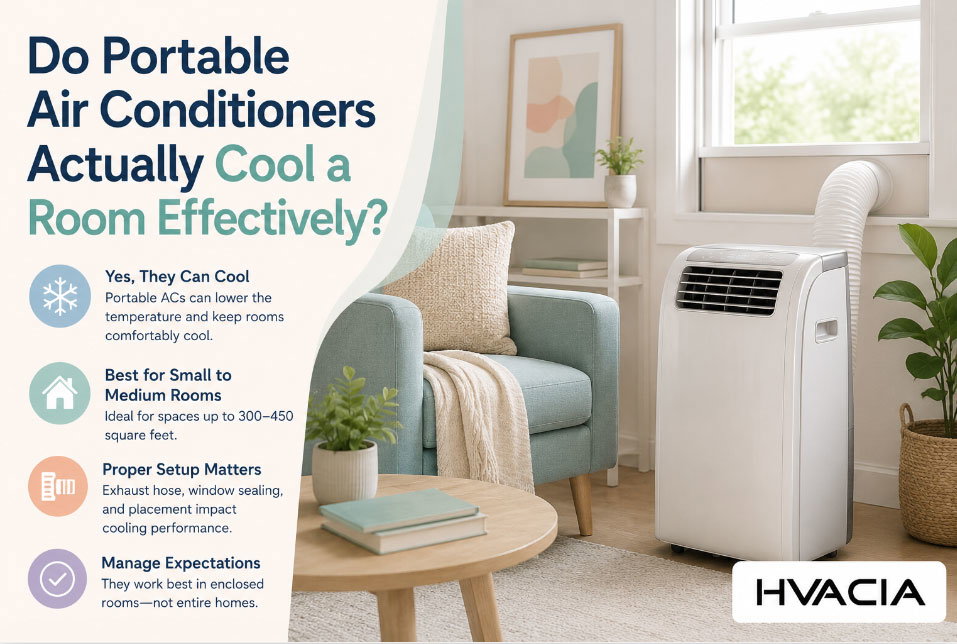
Short answer: yes, but with an asterisk the size of a garden hose. Portable air conditioners do cool a room — they just do it slower, less efficiently, and with more caveats than the box art suggests. If you've ever wheeled one into a bedroom, aimed the exhaust hose out a cracked-open window, and waited... and waited... and wondered whether the thing is actually doing anything, you're not imagining it. The question "do portable air conditioners work" doesn't have a one-word answer. It has a "compared to what, and under what conditions" answer. That's what this piece is here to sort out.
The Honest Answer: They Work, Just Not as Hard as a Window Unit
Every portable AC uses the same refrigeration cycle as a window unit or a central system — a compressor, a refrigerant, a condenser coil, and an evaporator coil. The physics is identical. What differs is the plumbing, and that difference matters more than most shoppers expect.
A portable unit sits inside the room it's cooling and vents its heat through a hose that runs to a window kit. That single design choice — heat exhaust routed through flexible ducting instead of a sealed box mounted in a wall or window frame — is the source of nearly every complaint people have about these machines. It's also why independent lab testing from organizations like Consumer Reports has historically found portable air conditioners delivering only middling results compared to other cooling options — for years, not a single model in their testing pool earned a full recommendation. That's not a marketing problem. It's a physics problem baked into the category.
None of that means portable ACs are useless. It means "do portable air conditioners work" is really three separate questions: do they lower the temperature (yes), do they lower it as fast and as far as other AC types (usually not), and is that gap big enough to matter for your specific room (depends entirely on size, sun exposure, and which type of portable unit you buy).
How Portable Air Conditioners Actually Cool a Room
To understand where the performance gap comes from, it helps to know what's happening inside the unit while it's running.
The Basic Mechanism
A portable AC pulls warm room air across a cold evaporator coil. The refrigerant inside that coil absorbs heat and humidity from the air, which comes out the front noticeably cooler and drier. That heat then has to go somewhere — it gets carried by the refrigerant to the condenser coil, where a fan blows it out through the exhaust hose and, ultimately, out the window. This is the exact same loop a window unit runs. The difference is what happens to fill the gap left behind.
Single-Hose Units: The Budget Standard
Single-hose portable ACs are the most common and least expensive design. They pull air from inside the room, cool part of it, and exhaust the leftover hot air outside through one hose. The catch: every cubic foot of air pushed outside has to be replaced by a cubic foot of air pulled in from somewhere. Since the unit only has one hose, that replacement air gets drawn in through door gaps, window seals, and any other crack in the room's envelope — and it's almost always warmer, more humid outdoor or hallway air. Industry write-ups describe this as negative air pressure, and it forces the unit to keep re-cooling air it just lost, which is a big part of why single-hose models struggle in larger or leakier rooms, as explained by CompactAppliance.
Dual-Hose Units: The Efficiency Upgrade
Dual-hose portable ACs add a second hose dedicated purely to intake. Instead of pulling replacement air from inside the room, they pull it from outside to cool the condenser coil, then vent it back out through the second hose without ever mixing it with the room's air. Because the room doesn't lose air pressure, there's less warm-air infiltration to fight, and the compressor doesn't have to work as hard to hold a temperature. According to product comparisons from Danby and Forbes Vetted, dual-hose units cool larger and sun-exposed rooms noticeably faster and more consistently than single-hose models, though they typically cost more and take up slightly more floor space for the second hose kit.
Evaporative "Portable ACs" Aren't True Air Conditioners
A separate category — sometimes marketed as personal or mini portable ACs, misting fans, or "swamp coolers" — doesn't use refrigerant at all. These units cool by evaporating water and blowing the resulting cooler, moister air across your immediate area. They can genuinely make you feel cooler standing directly in front of them, especially in dry climates, but they add humidity rather than remove it, and they don't lower the actual temperature of a room the way a compressor-based unit does. If a listing doesn't mention a compressor, refrigerant, or a BTU rating alongside an exhaust hose, it's this category — worth knowing before you compare it against a real portable AC on price alone.
Why Portable ACs Underperform Window and Central Systems
Three structural issues explain most of the performance gap, and none of them are fixable by buying a "better" brand.
Heat gain through the hose. The exhaust hose runs through the warm room air on its way to the window. Warm hot-air is passing through a duct sitting inside a room you're trying to cool — some of that heat radiates back into the room before it ever escapes outside.
Imperfect window seals. The foam or plastic window kit that portable units ship with rarely seals as tightly as a purpose-built window AC's cabinet. Gaps around the kit let outdoor heat and humidity leak back in continuously.
Self-evaporation and condensate reheating. Many modern portable units evaporate the water they pull out of the air and vent the resulting vapor back outside through the exhaust hose — convenient because you don't need to empty a bucket, but it adds a step that consumes some of the unit's own cooling capacity to process.
None of these issues exist in a window unit, where the entire hot side of the system sits outside the building in a sealed sleeve, or in a ductless mini-split, where the compressor lives outdoors entirely.
What Independent Testing Actually Shows
This is where "do portable air conditioners work" gets a real, measured answer instead of a marketing claim. In lab testing described by Consumer Reports, portable units took roughly 20 minutes on average to drop a test chamber by just 5 degrees Fahrenheit, while the strongest window air conditioners cooled a room by 10 degrees in about 15 minutes — twice the temperature drop in less time. That gap is the clearest evidence that the category's core limitation is real and measurable, not anecdotal.
It's worth noting this isn't a static verdict. Consumer testing in 2026 has started to surface standout models — inverter-driven units in particular — that post meaningfully better cooling-performance scores than the category average, so "portable ACs are mediocre" is becoming less true of the best models and more true of the bottom of the market. The practical takeaway: within the portable AC category, the spread between a weak single-hose unit and a strong inverter-driven dual-hose unit is large enough that shopping carefully matters more than it does for window units, where most models perform similarly.
Portable AC vs. Every Other Way to Cool a Room
| Cooling Type | Typical Efficiency | Avg. Upfront Cost | Installation | Best Room Size | Biggest Downside |
|---|---|---|---|---|---|
| Single-Hose Portable AC | Low (EER ~8–10) | $150–$350 | None — plug in, vent hose out a window | Up to ~250 sq ft | Negative pressure pulls warm air back in |
| Dual-Hose Portable AC | Moderate (EER ~10–12) | $350–$700 | None — two hoses through a window kit | Up to ~450 sq ft | Bulkier; still less efficient than window units |
| Window AC Unit | Good (EER ~10–15) | $150–$550 | Mounts in window frame; some DIY effort | Up to ~700 sq ft (large units) | Blocks the window; needs a compatible window |
| Ductless Mini-Split | Excellent (SEER 20–35+) | $2,000–$10,500 installed | Professional install; outdoor compressor | Single room to whole home (multi-zone) | High upfront cost |
| Evaporative ("Swamp") Cooler | Not BTU-rated (CFM-based) | $80–$400 | None, or simple ducting for whole-house units | Varies; best in dry climates | Adds humidity; ineffective in humid air |
| Central Air (Whole-Home) | Very Good (SEER 14–20+) | $4,000–$12,000+ installed | Professional install; ductwork required | Whole home | Major installation cost and disruption |
The pattern across every serious source is the same: portable ACs win on flexibility and zero installation, and they lose on efficiency to almost everything else on the list. That trade-off is the honest heart of the "do portable air conditioners work" question — they work well enough to be worth owning in the right circumstances, but they're rarely the most effective square-foot-for-dollar option if a window unit or mini-split is actually on the table.
Sizing It Correctly Matters More Than the Brand You Choose
An undersized or oversized unit will underperform regardless of hose configuration, and sizing mistakes are the single most common reason people conclude "my portable AC doesn't work" when the real issue is a BTU mismatch.
ENERGY STAR publishes a standard sizing chart based on square footage, with adjustments layered on top: reduce capacity by 10% for a heavily shaded room, increase it by 10% for a very sunny one, add 600 BTUs for each person regularly occupying the space beyond two, and add roughly 4,000 BTUs if the unit is going in a kitchen. As a fast rule of thumb, plan on about 20 BTUs per square foot for a room with a standard 8-foot ceiling, then adjust from there.
A few reference points that come up constantly in buying guides:
- A 200-square-foot room generally needs about 8,000 BTUs.
- A 300-square-foot room generally needs about 10,000 BTUs.
- Rooms over roughly 400–500 square feet start pushing past what most single-hose portable units can realistically handle, which is where dual-hose models or a different cooling type take over.
Bigger isn't automatically better, either. An oversized unit cools the air quickly but shuts off before it has run long enough to pull humidity out of the room, leaving the space feeling cold and clammy rather than genuinely comfortable.
What It Actually Costs to Run One
Efficiency numbers only mean something once you translate them into a monthly bill, and this is where the gap between portable and other cooling types becomes real money rather than an abstract EER figure.
A typical single-hose portable AC in the 8,000–10,000 BTU range draws somewhere around 900 to 1,300 watts while running. Running it eight hours a day through a hot month can add somewhere in the neighborhood of $30 to $60 to an electric bill, depending on local utility rates and how hard the unit has to work against sun exposure and poor sealing. A comparably sized window unit, doing the same job with a higher EER, typically lands 15–25% lower on that same bill — the efficiency loss from routing heat through a hose isn't just a comfort issue, it's a recurring cost.
Dual-hose models narrow that gap because they don't waste energy re-cooling infiltrated warm air, but they rarely close it entirely. Where the math changes dramatically is a ductless mini-split: a properly sized unit can use roughly a third to a half the electricity of a portable AC for the same square footage, which is why the much higher installation cost of a mini-split often pays for itself over several cooling seasons in a room that's used constantly, even though it will never make financial sense for a room you cool a handful of days a year.
The takeaway for anyone comparing options on cost alone: a portable AC's low upfront price is real, but it's a trade against a higher running cost every season you use it — worth factoring in before assuming "cheaper to buy" means "cheaper overall."
Seven Ways to Make a Portable AC Actually Perform Better
If you already own one, or you've decided a portable unit is the right call for your space, these adjustments close most of the performance gap:
- Shorten and straighten the exhaust hose. Every bend forces the fan to work harder and lets more heat radiate back into the room; use the shortest straight run the window kit allows.
- Seal the window kit properly. Foam tape or a fitted insulation panel around the plastic slider kit stops outdoor heat and humidity from leaking back in around the edges.
- Close doors and shut vents to unused rooms. Every open doorway is another source of the warm replacement air a single-hose unit has to keep cooling.
- Add a ceiling or box fan. Circulating the cooled air helps it reach corners the unit's own airflow can't push into, and it's the single tip echoed across nearly every appliance testing organization.
- Block direct sunlight. Blackout curtains or reflective film cut a meaningful chunk of the heat load before the AC ever has to touch it.
- Run it before the room gets hot, not after. Portable units are far better at maintaining a temperature than dropping one quickly; starting it an hour before you need the room cool works better than blasting it once you're already uncomfortable.
- Empty or drain the condensate reservoir on non-self-evaporating models. A full tank trips a safety shutoff, and a unit that keeps cycling off isn't cooling anything.
When a Portable AC Is the Right Call — and When It Isn't
Portable units earn their keep in a specific set of situations: rentals where you can't install a window unit, buildings with sliding or oddly shaped windows that won't accept a standard AC bracket, rooms you need to cool only occasionally, or homes where you want to move cooling from room to room rather than run it everywhere at once.
They're the wrong call when a room gets serious afternoon sun, exceeds roughly 400–500 square feet, or when you have a standard double-hung window available — in that last case, a window unit will almost always outcool a portable AC of the same BTU rating for less money, simply because its entire hot side sits outside instead of routing heat through a hose inside the room. If you're cooling more than one or two rooms consistently, a ductless mini-split costs more upfront but closes the efficiency gap entirely and adds resale value a portable unit never will.
Frequently Asked Questions
Do portable air conditioners work as well as window units? No, not typically. Lab testing has consistently shown window units cooling rooms faster and by a greater margin than portable models of comparable BTU rating, largely because a window unit's hot side sits entirely outside the room instead of venting through an interior hose.
Do portable air conditioners work without a window? Not effectively. Every compressor-based portable AC needs somewhere to vent hot exhaust air, almost always through a window kit, a dryer vent adapter, or a drop-ceiling kit. Without an exhaust path, the unit will heat the room instead of cooling it.
Do portable air conditioners work in very hot or humid climates? They still cool the room, but performance drops in extreme heat and humidity, since the unit has to fight a larger temperature difference and process more moisture out of the air. Dual-hose models hold up noticeably better than single-hose models in these conditions.
Do portable air conditioners work for large, open-plan rooms? Generally not well, unless you size up significantly and choose a dual-hose model. Airflow doesn't travel around corners or through open doorways, so a unit rated for a given square footage will still struggle in an oddly shaped or open-plan space of the same size.
Are dual-hose portable air conditioners worth the extra cost? For rooms larger than about 250–300 square feet, rooms with direct sun exposure, or hot climates, yes — the efficiency gain is large enough to notice. For a small, shaded bedroom, a single-hose unit is usually sufficient and the cheaper option makes more sense.
How much can a portable AC actually lower the temperature? In controlled testing, a typical portable unit dropped a test room by about 5 degrees Fahrenheit in 20 minutes. Real-world results vary with room size, insulation, and how well the exhaust hose is sealed, but that's a reasonable baseline expectation rather than the double-digit temperature swings marketing photos sometimes imply.
The Bottom Line
Do portable air conditioners work? Yes — they run on the same refrigeration cycle as every other AC type, and they will lower the temperature of a room. What they don't do is match a window unit or mini-split BTU for BTU, largely because of how they exhaust heat rather than any flaw in the cooling technology itself. Size the unit correctly, choose dual-hose over single-hose for anything but a small shaded room, seal the window kit, and keep expectations tied to what independent testing actually shows rather than the marketing copy on the box — and a portable AC will do exactly the job it's built for: convenient, no-installation cooling for the rooms where a window unit simply isn't an option.