 USA

How to Vent a Portable AC Without a Window: 7 Real-World Fixes That Actually Work
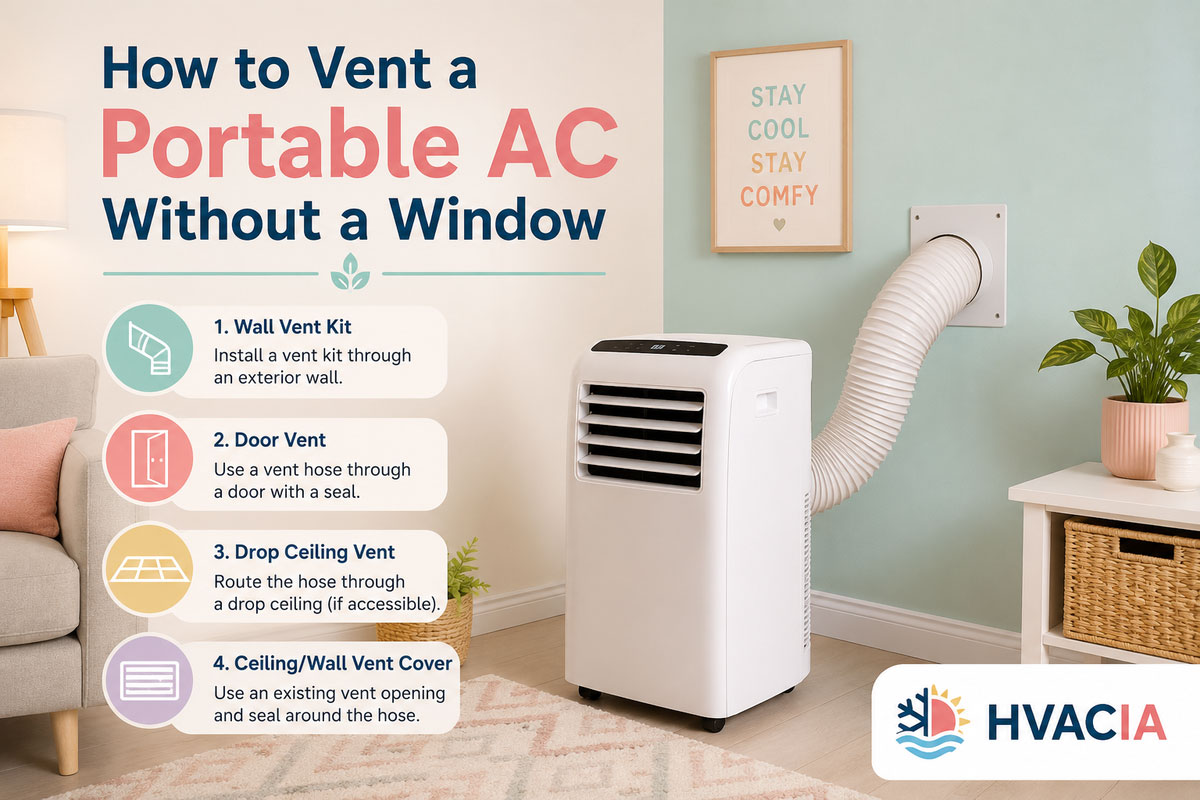
A portable air conditioner is only as good as its exhaust hose. Cut off that hose from the outside world, and you don't have a cooling machine — you have a very expensive fan that recirculates warm, humid air back into the room it's supposed to be chilling. That's the paradox anyone shopping for a windowless bedroom, basement, server closet, or interior office runs into almost immediately: the unit promises "portable" freedom, but the fine print assumes you have a window to vent it through.
The good news is that a window is convenient, not mandatory. Homeowners, renters, and facility managers have been finding ways to vent portable AC without a window for decades, using sliding doors, drop ceilings, dryer vents, and exterior walls. This guide walks through every legitimate method, ranks them by cost and difficulty, and flags the safety details that too many quick-tip articles skip over.
Why Venting Actually Matters for a Portable AC
Every portable air conditioner — single-hose or dual-hose — works by pulling warm air from the room across a set of refrigerant coils, then pushing that heat energy out through an exhaust hose. If the hose empties into the same room, or into a sealed closet with nowhere for the hot air to go, the unit is fighting itself: cooling air with one hand while dumping heat back in with the other. Compressors run longer, electric bills climb, and the room never quite reaches the temperature on the thermostat.
There's a second, subtler problem with single-hose units specifically. As the hose exhausts air outdoors, it creates negative pressure inside the room, which pulls in makeup air from wherever it can find a gap — often a doorway, an outlet, or a poorly sealed baseboard. If that makeup air is hot attic air or humid outdoor air, the AC has to work even harder. This is one reason a window air conditioner is typically 20 to 30% more energy efficient than a portable AC with the same BTU rating, largely because window units vent heat more directly outside and avoid the negative-pressure problem that single-hose portables create. None of that changes the fact that a huge number of apartments, dorms, and interior rooms simply don't have a window to work with — which is exactly why alternative venting exists.
Single-Hose vs. Dual-Hose: Does It Change How You Vent?
Not fundamentally — both designs still need one exhaust path to the outside. The difference is what that hose is doing. A single-hose unit uses one hose to both exhaust hot air and, in the process, depressurize the room slightly. A dual-hose unit adds a second hose that draws in outside air specifically to cool the condenser, which keeps the room's air pressure more balanced and generally cools faster with less strain on the compressor.
For someone trying to vent a portable air conditioner without a window, this matters mostly at the planning stage: a dual-hose unit means two openings to route (either two holes, or a single dual-port panel/kit), while a single-hose unit only needs one. If you're building a through-wall or drop-ceiling solution from scratch, it's worth deciding on hose configuration before you start cutting anything.
7 Ways to Vent a Portable AC Without a Window
1. Vent Through a Sliding Glass Door or Patio Door
This is the most common workaround, and for good reason — it requires no cutting, no drilling, and no permanent alteration. If your room has a sliding door but not a window, you can purchase a kit to vent the AC through the door. These kits are typically an adjustable acrylic or plexiglass panel that slides into the door track in place of the glass panel, with a round port sized for your hose diameter.
Installation is genuinely simple: open the sliding door, insert the vent panel into the door's bottom track, adjust the height until it fits snugly into the top track, attach the exhaust hose to the AC unit, connect the other end to the panel, and seal any gaps around the hose with weatherstripping. The main limitation is hose length — most portable AC hoses run five to seven feet, so the unit needs to sit reasonably close to the door.
2. Vent Through a Drop Ceiling or Suspended Ceiling
Offices, basements, and finished garages with suspended acoustic-tile ceilings have an easy hidden advantage: the plenum space above the tiles is often already connected to the outside through soffit vents or an HVAC chase. To vent a portable AC without a window using this route, you'll cut a hole in a ceiling tile slightly smaller than the venting adapter for a snug fit, insert the adapter, connect one end of the hose to the ceiling adapter and the other to the AC, then place the tile back into the grid while making sure the hose isn't pinched. Some installers prefer removing a whole tile and mounting a dedicated metal insert instead of cutting into a single tile, which holds up better over a full cooling season.
Before starting, confirm where that ceiling void actually vents to — a drop ceiling that only connects to another enclosed room won't solve anything.
3. Vent Through an Exterior Wall
For a permanent or semi-permanent installation, a through-wall vent kit is the closest thing to a purpose-built solution. The process: assess the length of your vent hose and the proximity to an electrical outlet when choosing a location, mark the spot for the hole, avoid pipes or power lines, cut the hole with a hole saw or reciprocating saw, connect the hose through the opening, cover the exterior side with a vent cap to keep out rain and pests, and seal the perimeter with caulk or weatherstripping.
This is the most labor-intensive option on this list, and it's also the one where getting a professional opinion pays off — particularly on load-bearing walls, brick or masonry exteriors, or any wall with wiring or plumbing you can't clearly see. It's best to speak to a professional to verify all safety concerns before drilling into an exterior wall.
4. Vent Through an Existing Dryer Vent
If there's a laundry room or utility closet nearby with an unused or accessible dryer vent, it can double as an AC exhaust path. The steps are straightforward: confirm the dryer vent is large enough for the AC hose and is accessible, get a venting kit with a hose and adapter for the dryer vent, remove the cover or grille to expose the duct, connect the adapter to both the hose and the duct, and use sealant or tape for a tight fit.
One caveat worth flagging: if the dryer itself is still in use, you'll need a way to disconnect the AC setup before running a load of laundry, or a splitter designed for dual use. This method works best when the dryer vent is dedicated or rarely used.
5. Vent Through a Standard Hinged Door
Sliding doors get most of the attention, but a regular swinging door can be vented too, usually with a DIY panel rather than an off-the-shelf kit. Measure the door's width, height, and the AC hose diameter, then prepare a door vent panel — either a purchased kit or a DIY cut from plexiglass or foam board with a hole sized for the hose. The panel typically mounts in the lower portion of the door frame or in a temporarily installed track, and the door is propped or sealed around the panel edges. It's less elegant than a sliding-door kit, but for renters who can't modify a wall, it's a legitimate no-drill option — and one of the more overlooked answers to how to vent a portable AC without a window in a strictly interior room.
6. Vent Into an Adjacent Room With a Window or Door to Outside
When the room you're cooling has no exterior access at all — a true interior room — the exhaust hose can sometimes run into a neighboring room that does have a window, with that room's own window kit installed as normal. If there's another room nearby with a window, you may be able to vent the air conditioner into that room, running the hose through a doorway gap or a small cased opening.
This isn't ideal — you're pushing heat into a space you're not actively cooling, and hose length becomes a real constraint — but for a windowless interior office or nursery next to a room that does have a window, it can be the most practical short-term fix.
7. Vent Through a Chimney or Unused Flue
Less common, but workable in older homes with a decommissioned fireplace or chimney flue nearby. You can get rid of the warm air produced by the air conditioner by piping the exhaust out through the chimney, typically by running the hose into the flue opening and sealing around it so heat doesn't leak back into the room. This only makes sense if the chimney is not in active use for a wood stove or fireplace during cooling season, and the flue should be checked for a clear, unobstructed path to open air.
Venting Options Compared
| Method | Upfront Cost | Difficulty | Permanence | Best For |
|---|---|---|---|---|
| Sliding door kit | $ | Easy | Removable | Apartments, patios, balconies |
| Drop ceiling vent | $$ | Moderate | Semi-permanent | Offices, finished basements |
| Through-wall vent | $$$ | Hard | Permanent | Long-term or year-round setups |
| Dryer vent adapter | $ | Easy–Moderate | Removable | Laundry rooms, utility closets |
| Hinged door panel | $ | Moderate | Removable | Renters, interior rooms with a door |
| Adjacent-room venting | $ | Easy | None (no cutting) | Windowless interior rooms |
| Chimney/flue venting | $ | Moderate | Removable | Older homes with unused flues |
Costs are relative, not fixed quotes — actual pricing depends on your hose diameter, wall material, and whether you buy a manufacturer kit or build a DIY panel from acrylic or foam board.
Safety First: What to Check Before You Cut, Drill, or Duct
A few precautions apply no matter which method you choose:
Never seal the exhaust into a fully enclosed, unvented space. The hot exhaust air needs somewhere to actually go — a sealed wall cavity, closed attic pocket, or dead-end duct will just build up heat and moisture, sometimes with mold or condensation problems as a result.
Check for wiring, plumbing, and structural framing before cutting into any wall or ceiling. A stud finder and a flashlight go a long way toward avoiding an expensive mistake.
Keep exhaust away from combustion appliances. If you're routing anything near a water heater, furnace, or gas dryer, maintain clearance and don't obstruct existing venting for those appliances.
Seal every gap around the hose. Any air conditioner installation — windowed or not — can leak as much as a 6-square-inch hole if not properly sealed, which quietly undercuts the efficiency gains of a well-planned vent.
For general product safety questions, recalls, or complaints related to air conditioning equipment, the U.S. Consumer Product Safety Commission is the federal body responsible for oversight. Its headquarters is located at 4330 East-West Highway, Bethesda, MD 20814, with a consumer hotline at 800-638-2772.
Choosing an Energy-Efficient Portable AC for a Windowless Room
Because indirect venting methods are rarely as airtight as a factory window kit, starting with an efficient unit pays off twice over. ENERGY STAR-certified room air conditioners meet efficiency requirements detailed in the program's key product criteria, and a dual-hose inverter portable AC can use up to 50% less electricity than a single-hose standard model — a meaningful difference if you're already losing some efficiency to a workaround vent.
A few sizing and shopping notes worth keeping in mind:
- Match BTU to room size rather than assuming bigger is better. An oversized air conditioner is actually less effective and wastes energy, partly because it cools the room before it has time to remove humidity, leaving the space feeling damp.
- Look for the EER or CEER rating, not just the ENERGY STAR label alone, when comparing two certified models.
- Favor dual-hose designs if you're venting through a drop ceiling, wall, or dryer duct, since they handle the added duct length and any minor pressure imbalance better than single-hose units.
Full buying guidance and a certified product finder are available through the ENERGY STAR Room Air Conditioners program, a joint initiative of the U.S. Environmental Protection Agency, headquartered at 1200 Pennsylvania Avenue NW, Washington, DC 20460.
Maintaining Your Vent Setup Season After Season
Whichever method you land on, a little upkeep keeps it performing like day one:
- Clean or replace the filter regularly. A dirty filter restricts airflow and forces the compressor to work harder for the same cooling output.
- Inspect the hose and vent panel for gaps twice a season. Weatherstripping and foam seals compress and shift over time, especially around door and window-panel kits.
- Empty or check the condensate reservoir if your unit isn't self-evaporating, and confirm any drain line stays clear.
- Re-check ceiling or wall vent caps before summer for pests, debris, or nesting that may have built up in the off-season.
Frequently Asked Questions
Can you actually use a portable air conditioner without a window? Yes. As long as the exhaust hose has some path to the outside — a sliding door, drop ceiling, exterior wall, dryer vent, or even a neighboring room's window — the unit will function. What you can't do is run it with the hose blocked or dumping straight back into a sealed room.
Is it safe to vent a portable AC through a dryer vent? Generally yes, provided the vent isn't actively needed for an in-use dryer at the same time, and the connection is sealed well enough to prevent exhaust leaking back into the room.
Do "ventless" portable air conditioners exist? Products marketed this way are typically evaporative coolers, not true refrigerant-based air conditioners, and they work by a completely different (and much less powerful) process. A genuinely ventless refrigerant air conditioner isn't a real category — every compressor-based portable AC needs somewhere for the extracted heat to go.
Which venting method is cheapest? Sliding door kits and adjacent-room venting typically cost the least, since neither requires cutting into a wall or ceiling.
Will venting without a window make my AC less efficient? It can, if seals are loose or ductwork is longer than a standard window kit. Choosing a dual-hose, higher-EER unit and sealing every gap carefully narrows that efficiency gap considerably.
Resources & Further Reading
- ENERGY STAR — Room Air Conditioners — U.S. EPA, 1200 Pennsylvania Avenue NW, Washington, DC 20460
- ENERGY STAR — Key Product Criteria for Room Air Conditioners
- U.S. Consumer Product Safety Commission — 4330 East-West Highway, Bethesda, MD 20814
- ASHRAE — 180 Technology Parkway, Peachtree Corners, GA 30092 (technical ventilation and indoor air quality standards)
Final Thoughts
The absence of a window shouldn't be the deciding factor in whether a portable air conditioner belongs in a room. Between sliding-door kits, drop-ceiling adapters, through-wall installations, dryer vent connections, hinged-door panels, adjacent-room routing, and the occasional unused chimney flue, there's a workable path for nearly every layout. The real variables are how permanent you want the solution to be, how much drilling you're willing to do, and how tightly you seal the finished setup — because in venting, as in most home comfort projects, the details around the edges matter as much as the method itself.