 USA

Gas vs. Electric Furnaces: Which Is Right for Your Home?
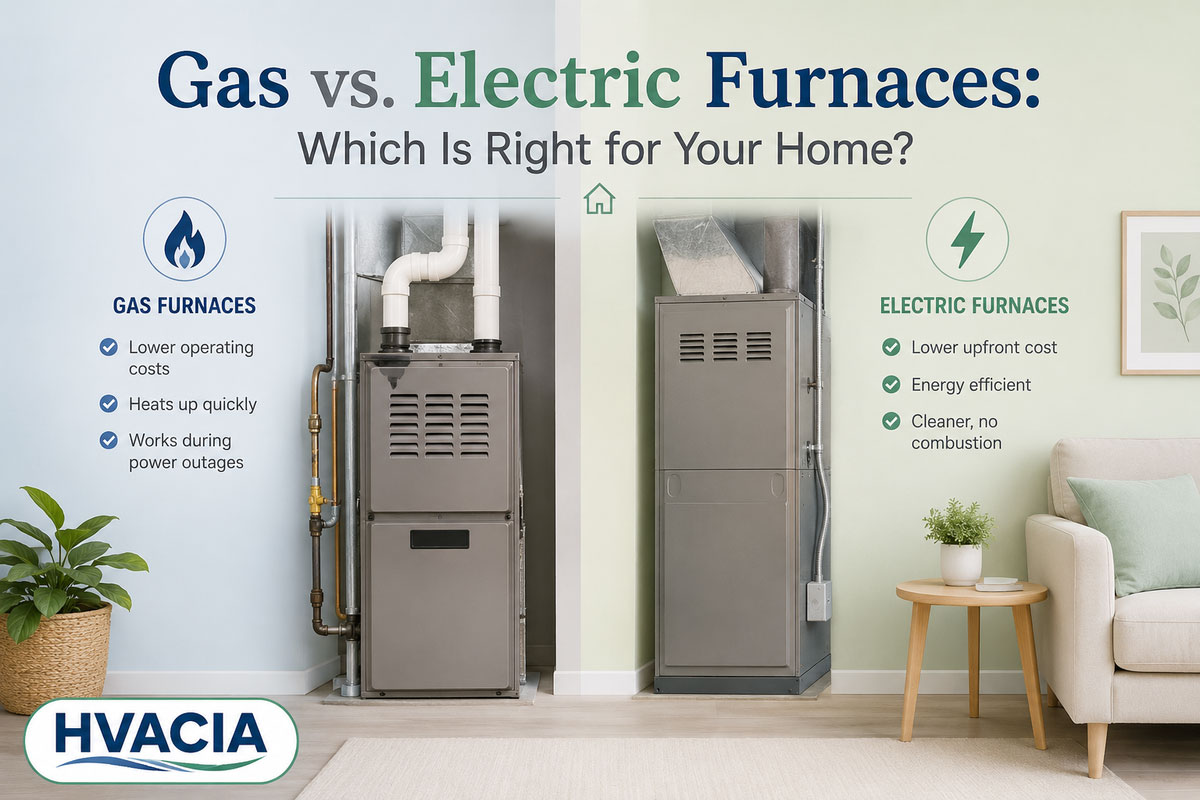
Every furnace shopping trip eventually comes down to the same fork in the road: gas or electric. It sounds like a simple either-or question, but the right answer depends on your climate, your utility rates, the age and condition of your ductwork, and even the direction your local energy grid is heading. This guide walks through the real differences — not just the marketing talking points — so you can make a decision that holds up for the next fifteen to twenty years, not just the next winter.
How a Gas Furnace Actually Heats Your Home
A gas furnace burns natural gas or propane inside a sealed combustion chamber. The heat produced warms a metal heat exchanger, and a blower fan pushes air across that hot surface and through your ductwork. Combustion byproducts exit through a flue or vent pipe, which is why gas furnaces require a dedicated exhaust route and, in most jurisdictions, a carbon monoxide detector nearby.
Because combustion generates a lot of heat very quickly, gas furnaces tend to produce hotter air at the supply registers — often in the 120 to 140°F range — and they recover quickly after a thermostat setback. That's part of why gas heating has historically dominated in colder regions: it can outpace heat loss even on the coldest night of the year without breaking a sweat.
Modern gas furnaces are rated by AFUE (Annual Fuel Utilization Efficiency), and the best condensing models now reach 96 to 98.5% efficiency, meaning almost none of the fuel's energy is wasted up the flue. That's a big jump from furnaces installed in the 1990s, many of which topped out around 78 to 80% AFUE.
How an Electric Furnace Actually Heats Your Home
An electric furnace works on a much simpler principle: electricity runs through resistance coils, similar to what's inside a toaster or space heater, and a blower pushes air across those hot coils and into your ducts. There's no combustion, no flue, and no fuel line — just a breaker panel connection and a blower.
Because there's no combustion loss, electric furnaces are rated at essentially 95 to 100% efficiency at the point of use — nearly all the electricity that enters the unit becomes heat. That efficiency number is a bit misleading on its own, though, since it doesn't account for how the electricity was generated upstream, or how much it costs per unit of heat compared to gas. We'll get into both of those below.
Electric furnaces are simpler mechanically, which means fewer components to fail, no risk of gas leaks or carbon monoxide exposure, and generally lower maintenance costs. They're also common in homes without gas service — new construction in gas-restricted municipalities, all-electric condos, and rural properties far from a gas main.
Gas vs. Electric Furnaces at a Glance
| Factor | Gas Furnace | Electric Furnace |
|---|---|---|
| Typical unit cost | $1,500–$4,500 | $1,000–$3,500 |
| Total installed cost | $4,000–$9,500 | $2,500–$6,500 |
| Average lifespan | 15–20 years | 20–30 years |
| Efficiency rating | 80–98.5% AFUE | 95–100% at point of use |
| Air temperature at register | 120–140°F | 95–115°F |
| Annual operating cost (national avg.) | $700–$1,200 | $1,000–$1,800 |
| Best climate fit | Cold and mixed climates | Mild and temperate climates |
| Requires gas line/flue | Yes | No |
| Carbon monoxide risk | Yes, if unmaintained | None |
| Maintenance frequency | Annual professional tune-up recommended | Less frequent, fewer moving parts |
| Noise level | Moderate (ignition, blower, flue draft) | Quieter (blower only) |
| Environmental footprint | Higher direct emissions | Depends on local grid mix |
Upfront Cost: What You'll Pay to Install Each System
The purchase price gap between gas and electric furnaces is real but often smaller than people expect once installation labor is factored in. A gas furnace generally costs more upfront because of the added complexity: venting, gas line connections, and combustion safety components like a heat exchanger and pressure switch. An electric furnace skips all of that, which is why installed electric systems often run several thousand dollars less than a comparable gas setup.
That said, the math changes quickly if your home doesn't already have the right electrical service. A century-old house with a 100-amp panel might need an electrical upgrade to safely run an electric furnace, especially one paired with electric resistance backup heat for a heat pump. Conversely, a home without an existing gas line will need one trenched in from the street, which can add thousands of dollars depending on distance and local permitting.
Consider a mid-century home on Larkspur Avenue in Denver that currently runs on an aging electric furnace. Upgrading to a similarly sized gas unit there would mean not just the furnace itself, but a new gas meter, service line, and inspection — costs that can rival or exceed the price difference between the two furnace types. In a case like that, sticking with electric (or pairing it with a heat pump) is often the more cost-effective path, even in a cold-winter city.
Operating Costs: The Monthly Bill Difference
This is where regional utility rates matter more than almost any other factor. Natural gas is priced by the therm, and electricity is priced by the kilowatt-hour, and the exchange rate between the two varies enormously by state and even by utility provider within the same state.
In much of the Midwest and South, natural gas remains significantly cheaper per unit of heat delivered than electric resistance heat, which is why gas furnaces still dominate those markets despite electric's higher point-of-use efficiency. In the Pacific Northwest, where hydroelectric power keeps electricity rates low, the gap narrows considerably. In the Northeast, where electricity prices are among the highest in the country, a gas furnace can cost noticeably less to run over a heating season than straight electric resistance heat.
A useful way to estimate this for your own home is to check your utility's published rate per therm and per kWh, then compare against a furnace's rated output. The U.S. Energy Information Administration publishes updated regional energy price data at eia.gov, which is a good first stop before assuming national averages apply to your zip code.
Efficiency Ratings Explained: AFUE and What It Means for You
AFUE measures how much of the fuel's energy actually becomes usable heat in your home versus how much escapes as exhaust. A furnace rated at 96% AFUE converts 96 cents of every fuel dollar into heat; the rest is lost through the flue.
Electric furnaces don't carry an AFUE rating in the same way, because there's no combustion and essentially no venting loss — nearly all the electrical energy delivered to the unit becomes heat. The catch is that this number only reflects what happens inside your house. If your electricity comes from a natural gas or coal power plant that's itself only 40 to 50% efficient at generating power, and then loses more in transmission, the "full-cycle" efficiency of electric heat can be lower than it first appears — though this calculation is shifting as more grids add wind, solar, and hydro capacity.
For shoppers who want to compare specific furnace models side by side, the ENERGY STAR certified product database lists AFUE ratings and estimated annual operating costs for both gas and electric equipment, and it's a far more reliable source than a sales brochure.
Climate Matters More Than You Think
Cold climates put a premium on rapid, high-output heat, and this is the single biggest reason gas furnaces remain the default in places like Minnesota, Montana, and upstate New York. On a night when outdoor temperatures drop below zero, a gas furnace's ability to push very hot air through the ducts keeps a home comfortable without running constantly.
Electric resistance furnaces can absolutely keep a house warm in extreme cold — they're used as backup heat in heat pump systems everywhere from Maine to Alaska — but as a sole heat source in a very cold, poorly insulated home, they can lead to higher bills than gas simply because electricity is often the pricier fuel per unit of delivered heat in cold-climate states.
In milder regions — coastal California, the Southeast, and much of the Southwest — the calculus flips. Heating loads are lower and shorter, so the higher per-unit cost of electricity matters less, and many of these homes don't have gas service to begin with. A single-story ranch on Sabal Palm Court outside Orlando, for instance, might run its electric furnace for only a handful of weeks a year, making the fuel cost difference almost irrelevant next to the simplicity and lower upfront cost of going electric.
Environmental Impact and the Electrification Question
Gas furnaces burn fossil fuel directly inside the home, producing carbon dioxide and other combustion byproducts that are vented outside. Even the most efficient 98% AFUE gas furnace still has a direct emissions footprint tied to burning natural gas.
Electric furnaces have no on-site combustion, so their environmental footprint depends almost entirely on how the local grid generates power. In regions with a high share of hydro, wind, solar, or nuclear generation, an electric furnace's effective carbon footprint can be substantially lower than a gas furnace's. In regions still heavily reliant on coal or gas-fired power plants, the difference narrows or can even reverse, though grids nationwide are trending cleaner year over year. The U.S. Department of Energy tracks regional grid mix data and electrification research if you want to dig into your specific utility's generation profile.
This is also the reason many municipalities and states have shifted incentive programs toward electrification, favoring heat pumps and electric equipment in new construction, even in regions that have traditionally leaned on gas.
Safety Considerations
Gas furnaces are safe when properly installed and maintained, but they do carry risks that electric furnaces simply don't have: carbon monoxide leaks from a cracked heat exchanger, gas leaks from a failed valve or fitting, and the need for proper venting to avoid backdrafting exhaust into the home. This is why an annual professional inspection isn't optional for gas equipment — it's a genuine safety practice, not just a maintenance recommendation. A working carbon monoxide detector on every level of the home is essential wherever a gas furnace is installed.
Electric furnaces remove combustion entirely from the equation. There's no flue to crack, no gas line to leak, and no carbon monoxide risk from the unit itself. The main safety consideration with electric furnaces is electrical: making sure the circuit is properly sized and the panel can handle the load, which a licensed electrician should confirm before installation.
Maintenance and Lifespan
Gas furnaces have more components that can wear out — igniters, flame sensors, heat exchangers, gas valves — and benefit from a yearly professional tune-up to check for cracks, verify proper combustion, and clean the burner assembly. With that regular care, a quality gas furnace typically lasts 15 to 20 years.
Electric furnaces are mechanically simpler. There's no combustion assembly to inspect, no flue to check for blockages, and fewer failure points overall. Heating elements can wear out over time, especially with heavy cycling, but the reduced complexity generally translates to lower repair costs and, often, a longer service life — commonly 20 to 30 years with basic upkeep like filter changes and coil cleaning.
Rebates, Incentives, and the 2026 Reality
If you were planning your furnace purchase around the old federal 25C Energy Efficient Home Improvement Credit, it's worth knowing that this incentive has changed. The federal 25C tax credit expired at the end of 2025 under the One Big Beautiful Bill Act, so furnaces and heat pumps installed in 2026 no longer qualify for that federal credit. Homeowners who completed a qualifying install by the end of 2025 can still claim it on that tax year's return, but new 2026 purchases fall outside the program.
That doesn't mean the savings have disappeared entirely — it means the incentive landscape has shifted toward the state and utility level. DSIRE, the Database of State Incentives for Renewables and Efficiency maintained by NC State University since 1995, tracks federal, state, and utility incentives for energy efficiency and renewable energy across all fifty states, and it's the most reliable place to check what's currently available in your area at dsireusa.org. Many utilities still offer rebates for high-efficiency furnace installs, heat pump conversions, or electrical panel upgrades, so it's worth calling your provider directly before you sign a contract.
Making the Decision: A Practical Framework
Rather than treating this as a straight gas-versus-electric debate, it helps to run through a short checklist:
Do you already have a gas line to the house? If yes, staying with gas usually keeps installation costs lower. If no, adding one purely for a furnace rarely pencils out unless you're also adding a gas water heater, range, or dryer.
What does your utility charge for gas versus electricity? Pull your last twelve months of bills and compare cost per therm to cost per kWh, adjusted for a furnace's rated efficiency. This single comparison often settles the debate faster than any efficiency rating.
How cold does it get, and how well insulated is the house? Older, leakier homes in cold climates lean toward gas for its rapid, high-temperature output. Newer, well-insulated homes in milder climates can run comfortably and affordably on electric heat.
What's your electrical panel's capacity? An electric furnace, especially a larger one, draws significant amperage. If your panel is already near capacity, factor in the cost of an upgrade.
How long do you plan to stay in the home? Electric furnaces often last longer and cost less to maintain, which can matter more for a forever home than a house you plan to sell in five years.
Two Homes, Two Very Different Answers
Consider a four-bedroom colonial at 2210 Hartwell Ridge Road outside Pittsburgh. It has existing gas service, an aging 80% AFUE furnace, and winters that regularly dip into the teens. Here, replacing like-for-like with a high-efficiency 96% AFUE gas furnace makes the most sense: the infrastructure is already in place, the climate rewards fast recovery and high-temperature output, and the efficiency jump alone can meaningfully cut the gas bill.
Now consider a single-story stucco home at 748 Desert Marigold Way in Tucson. It has no gas service, mild winters, and a homeowner focused on lower upfront cost and simpler long-term maintenance. An electric furnace — or an electric furnace paired with a heat pump for even better cold-weather efficiency — fits both the climate and the infrastructure already in place. Running a new gas line here would add cost without a proportional benefit given how few heating hours the system actually logs each year.
Neither answer is universally "better." They're both correct for their specific house, climate, and utility rates — which is really the point of this whole comparison.
Frequently Asked Questions
Is an electric furnace cheaper to run than gas?
It depends entirely on local utility rates. In states with low electricity prices relative to gas, electric can be competitive or even cheaper. In states where gas is comparatively inexpensive, gas usually wins on monthly operating cost.
Do electric furnaces last longer than gas furnaces?
Generally, yes. Electric furnaces average 20 to 30 years thanks to fewer moving parts and no combustion wear, compared to 15 to 20 years for gas furnaces.
Which is safer, gas or electric?
Electric furnaces carry no carbon monoxide or gas leak risk since there's no combustion involved. Gas furnaces are safe with proper installation, annual inspection, and a working carbon monoxide detector, but they do carry risks electric systems don't.
Can I get a tax credit for a new furnace in 2026?
Not at the federal level for standard installs — the federal 25C credit expired for equipment placed in service after December 31, 2025. State and utility rebates may still apply, so check the DSIRE database or contact your utility directly.
Is it worth switching from gas to electric, or vice versa?
Only if your existing infrastructure supports the switch affordably. Adding a gas line where none exists, or upgrading an electrical panel from scratch, can erase most of the potential savings unless you're also making other upgrades that benefit from the same infrastructure.
The Bottom Line
There's no single correct answer to the gas-versus-electric furnace question — there's only the correct answer for your specific house, climate, and utility rates. Cold-climate homes with existing gas service usually do best sticking with high-efficiency gas equipment. Milder climates, homes without gas access, and buyers prioritizing simplicity and longevity often do better with electric. The smartest move before buying either one is pulling your actual utility rates, checking your electrical panel capacity, and getting a load calculation from a licensed HVAC contractor rather than relying on national averages that may not reflect what's happening on your own street.